April has brought temperatures surging into the low 20s Celcius accompanied by heavy rains. The warm, humid temperatures have prompted new growth. There is a haze of green appearing in the canopy. We long for cooler spring temperatures!

Komoka Ponds
Komoka Provincial Park is just west of London, along the Thames River. The Komoka Ponds, created from old gravel pits, lie beyond the main park. The ponds host a a variety of migrating waterfowl in early spring.
We were hopeful of seeing Eastern Meadowlarks that are usually found in the grassy flatland, Eastern Bluebirds, and Tree Swallows that inhabit the nesting boxes. On April 8, the forecast was for a high temperature of 8 C, but the brisk wind made it feel much colder.


As we set out, all was quiet and we began to wonder if there would be much to see. There were no birds on the first pond, but farther along the trail, we spotted small groups of American Wigeons, Ring-necked Ducks, Northern Shovellers, Buffleheads, and Gadwalls. There were also a couple of Mute Swans and a few Canada Geese on the water. All were too far away for good photos.
We scanned the reeds on the far side of the pond. Staring back at us was a Sandhill Crane! As we watched, the crane repeated its rattling bugle call.
You can hear the call here:
https://www.allaboutbirds.org/guide/Sandhill_Crane/sounds
Before long, a second crane emerged from the reeds and approached the first. Sandhill Cranes sometimes nest in the area, so perhaps this pair will take up residence.


We had a few other bird sightings, again at a distance too great for good photos. Still these are enough for identification…
Northern Flicker (Yellow-shafted)


A pair of American Kestrels that flew along the ponds and landed briefly.


This Eastern Phoebe was a little closer, but backlit by the sun.


A small flock of Dark-eyed Juncos (Slate-colored) landed briefly. The Ruby-crowned Kinglet was in constant motion…


Harris Park – April 10, 2026
The sun was shining and the day was warmer on April 10th. It was time to look for signs of spring in the neighbourhood!
So many birds were singing during our brief walk along the wooded trail beside the Thames River:
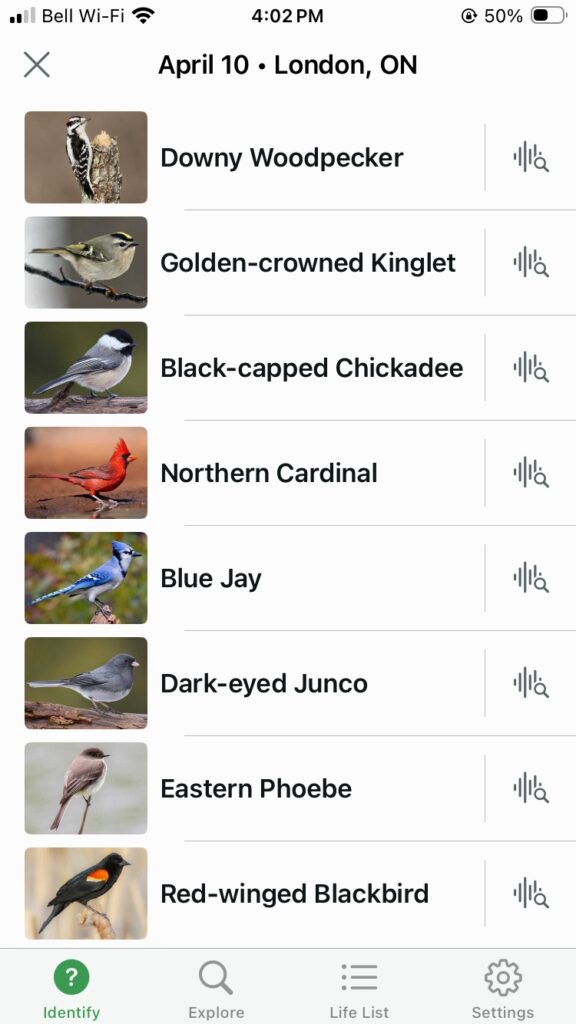
We didn’t see them all, but we did see these:
House Finch (male – two photos), Common Grackle, American Goldfinch (male), American Robin, Mallard (male), Mourning Dove.


One of the earliest plants to emerge, especially in wet places, is the Skunk Cabbage.


The scourge of Scilla (aka Siberian Squill)
Scilla blooms early and adds colour to the early spring landscape.


Although it may look attractive, Ontario’s Invading Species Awareness Program warns that it can form dense colonies that displace native spring flowering plants in woodlands. The plant was introduced as an ornamental, but easily escapes cultivation. Removal of Scilla requires special handling because of its toxicity. Its leaves, blooms, bulbs and seeds are all poisonous if consumed by humans, dogs or cats. It’s best to stick to native plants in our gardens.
Wandering Bee Tulips


The Music of Rachael Price
What a voice! I created two playlists because I hit some YouTube restriction.
https://www.youtube.com/watch?v=1xZxxVlu7BM&list=PLhsgho1ap5iqIcKmiYR0rRXUyh2HvTxf7
and
https://www.youtube.com/watch?v=wyRVeiuZeuY&list=PLhsgho1ap5ipHNo1Amo8kQ-LCEBMOEycX