The November snow has melted and we are enjoying mild, for November, temperatures as high as 8 °C (46.4 °F).
Just a few days ago, snow remained, and there were still a few leaves on the trees.


This week, the trees are mostly bare and the canopy mostly grey.
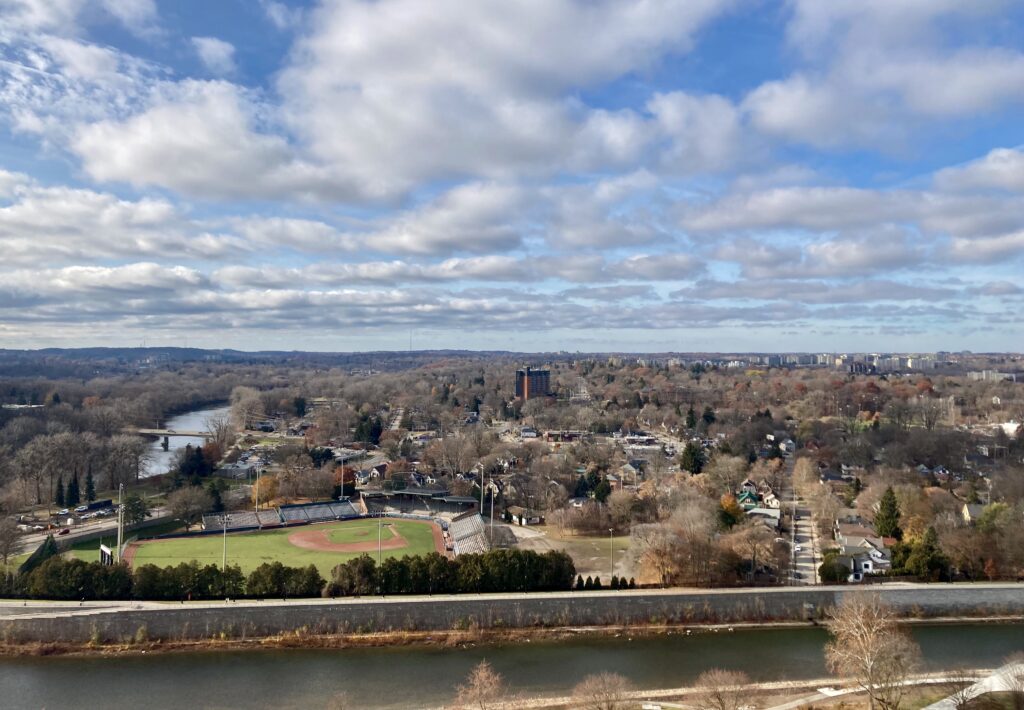
Colour now comes from the sunsets…


Our Sunday walk took us through Harris Park where Canada Geese congregated and Mallards dabbled in the river. A pair of Northern Cardinals made their way through the high tree tops.
A few asters bravely continued to bloom, but most had gone to seed.


After we crossed the river, we spotted a Great Blue Heron standing in a sheltered spot on the riverbank near the bridge. If it can find enough to eat, this bird may stay all winter. The sun lit its face with the rest of the bird in shade.


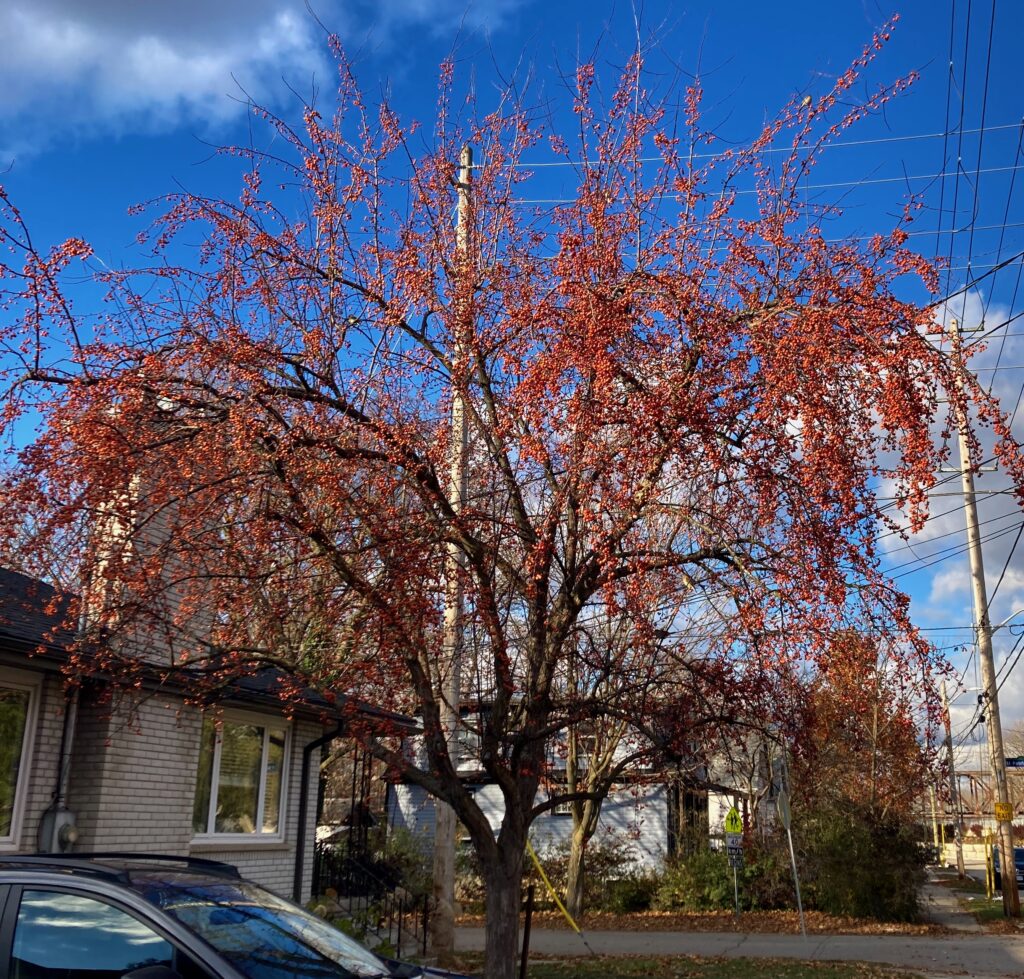
As we walked through the Blackfriars neighbourhood, we came across a crab apple tree laden with fruit. At first, we saw a few American Robins feasting in the tree and on the ground below the tree. As he took photos with his telephoto lens, Glenn noticed two Cedar Waxwings in the branches. Soon the waxwings were joined by several others.
Cedar Waxwings are short- to long-distance migrants. Some breed across Canada, north of the Great Lakes before heading south. Some winter as far south as Central America. Some Cedar Waxwings are present year round across southern Canada and the northern U.S.
Except during breeding season, waxwings feed mainly on different fruits that become available throughout the year. These might include serviceberry, mulberry, dogwood, cedar and juniper berries, mountain ash, honeysuckle, crabapple, hawthorn and Russian olive fruits. In winter, waxwings roam in flocks looking for fruit.
Many of the waxwings in this small flock were first-year birds. Some still showed light streaking on theirbreasts, and light grey backs. They did not yet have the red wingtips of most adult birds.


As we continued to watch, other birds joined the banquet. The word was out!
In the end, the Cedar Waxwings were joined by House Sparrows, American Robins, European Starlings, American Goldfinches, and House Finches. A Mourning Dove perched nearby.


On our way home, we spotted two Red-tailed Hawks circling overhead. One was an adult with a signature red tail. The second was a juvenile with a banded tail. We later watched as one of the hawks descended and landed just within the reach of Glenn’s long lens.


These are likely the local Red-tails that we have seen patroling the downtown area through the summer. They may remain all winter, rather than migrating farther south. Much like us…
Neil Young at 80
Choir Choir Choir’s concert at Massey Hall in honour of Neil’s 80th birthday. We have it on good authority that Neil can still bring it in concert…
Jimmy Cliff 1944 -2025
From Wikipedia, “He is considered one of Jamaica’s most celebrated musicians, and has been credited with helping to popularise reggae music internationally. “
This playlist includes three songs written and performed by Jimmy Cliff. The fourth is his version of a Johnny Nash song. Finally, another Jimmy Cliff song.