Author: New Admin

  • Rondeau Birds –            May 10 & 11, 2025

    Rondeau Birds – May 10 & 11, 2025

    May 10

    In addition to the Spicebush Trail, we spent time on several other trails at Rondeau in search of birds. The park offers a range of habitats that support different species. Some areas are more open woodland.

    Other trails involved walkways through wet woods.

    On our wildflower walk on the Spicebush Trail, we came across only a few birds. A House Wren was singing constantly, making its presence known.

    Yellow Warblers called from many locations and Tree Swallows soared overhead and occasionally landed.

    When we stopped for a picnic lunch, we watched Barn Swallows constructing their mud and stick nest under the eaves of a park washroom facility.

    We later saw another Barn Swallow gathering mud for nest contruction.

    From the covered picnic pavilion, we had good views of an Eastern Bluebird and a Chipping Sparrow high in a neighbouring tree.

    We were hoping to see warblers and, despite the challenges, photograph a few. Most warblers have travelled from much farther south and are on their way to the boreal forest to nest. They’ve stopped in Rondeau to refuel in preparation for their long journey and are frantically feeding on the insects that emerge in the spring. Warblers are in constant motion as they grab at insects and avoid being a target for predators.

    Here are some of the photos Glenn managed to capture on the South Point and Tulip Tree Trails.

    Blackburnian Warbler. Photographs don’t always do justice to the striking bright orange throats of these birds.

    Yellow-rumped Warblers are sometimes easier to capture, but this one was moving fast.

    This acrobatic Cape May Warbler emerged only briefly from behind leaves.

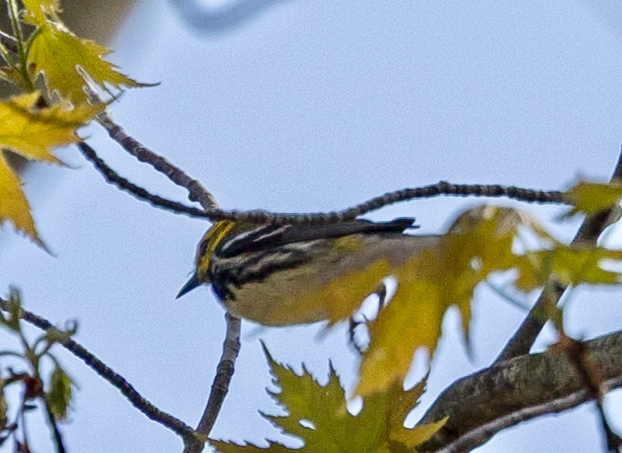
    This is all we saw of this Black-throated Green Warbler…
    We had not seen a Veery since our very first guided bird walk in High Park, almost 10 years ago. This year, we came across several during our time at Rondeau. Veerys are a type of thrush that forage on the ground and nest near the ground in damp, dense deciduous forests. They may nest in Rondeau or move farther north to nest.

    Pileated Woodpeckers nest in the park. It is always a thrill to see these prehistoric-looking birds. This bird’s red “mustache” indicates that it is a male.

    There was a great deal of excitment about a male Scarlet Tanager that had been seen fairly reliably along one trail. We kept an eye out and were finally rewarded to find the bird moving through the high branches. Again, these photographs don’t really capture the intense red of this stunning bird.

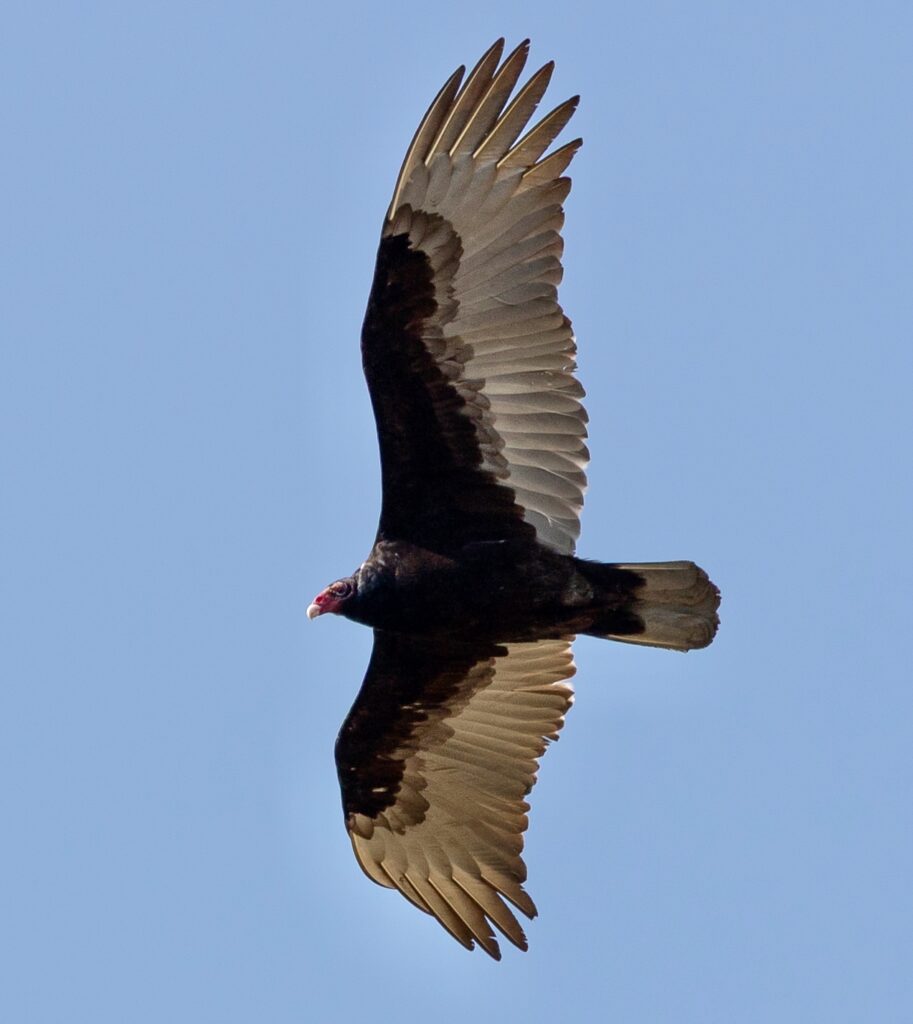
    Turkey Vultures are not beautiful birds, but they perform an essential ecosystem cleaning service by consuming carrion that otherwise could spread disease and bacteria in the environment.
    The drive through the park is always a treat.

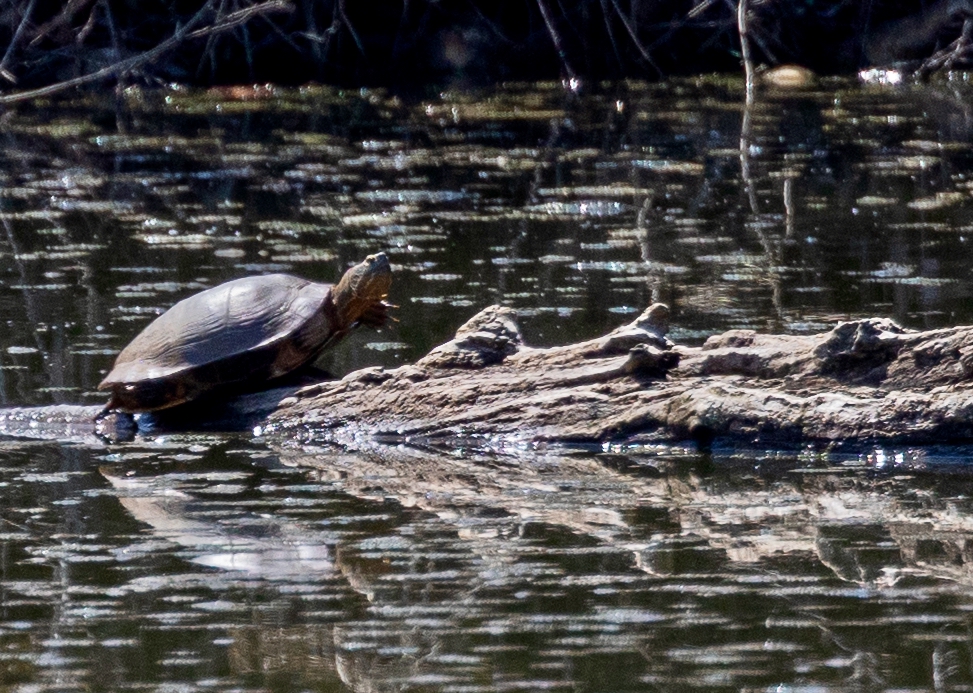
    At the end of the day, we had a view of Northern Map Turtles basking at a dock in the late afternoon sun.

    May 11

    The following day, we were ready to hit the trails and confront the challenges of photographing warblers again.

    On a lightly wooded trail in the morning, we found a few birds perching in the open – male Rose-breasted Grosbeak, American Robin, male Yellow Warbler – and a Northern Flicker foraging in the grass.

    Also moving through the grass, Glenn spotted this Eastern Garter Snake. We hadn’t seen one with this colour pattern before.

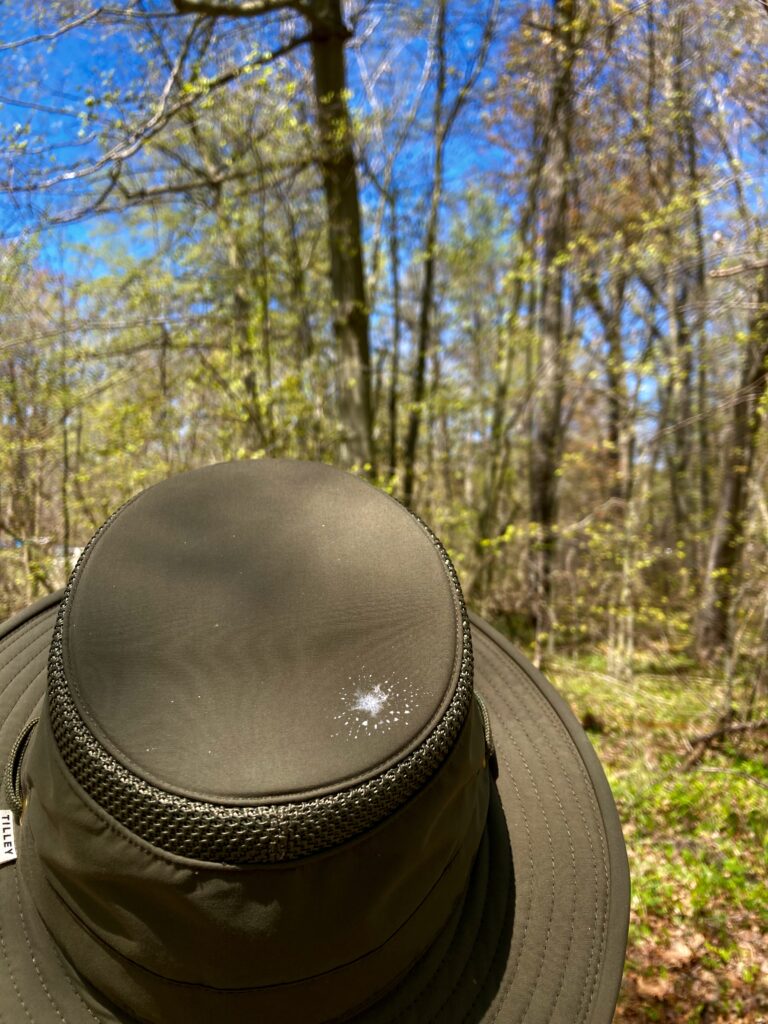
    On this trail, Glenn’s hat acquired a sign of impending good luck. We hoped it augured well in our search for warblers!
    Happily, we found a few!

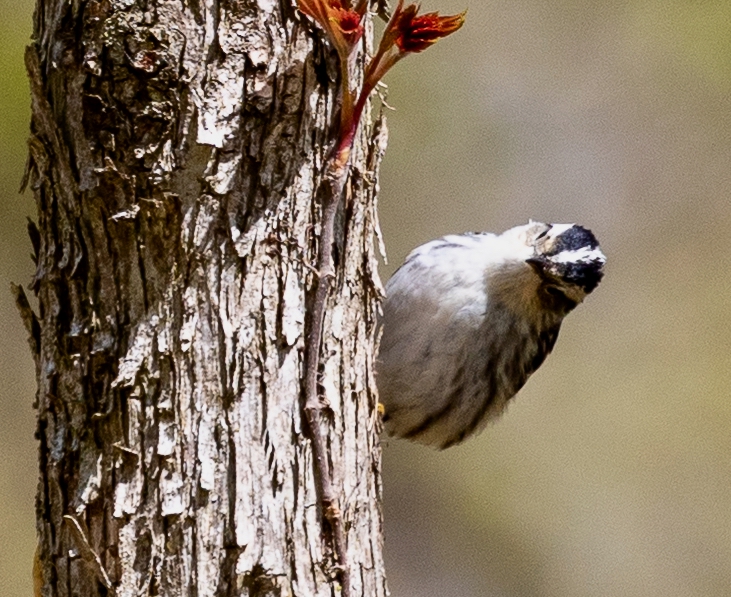
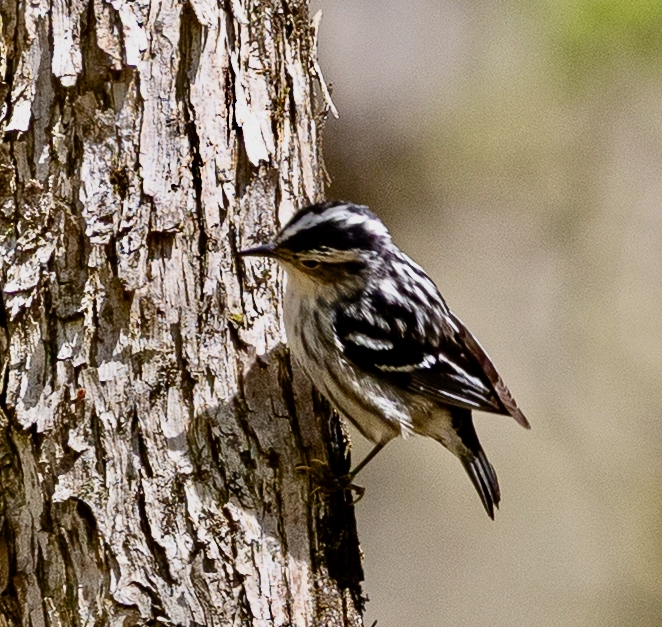
    Black and White Warblers forage on the trunks of trees, much in the way of nuthatches. We saw several throughout the day on both the Tulip Tree and Bennett Ave Trails.
    A Black-throated Blue Warbler moving constantly in the underbrush.

    Northern Parula and Nashville Warblers hiding in the leaves.

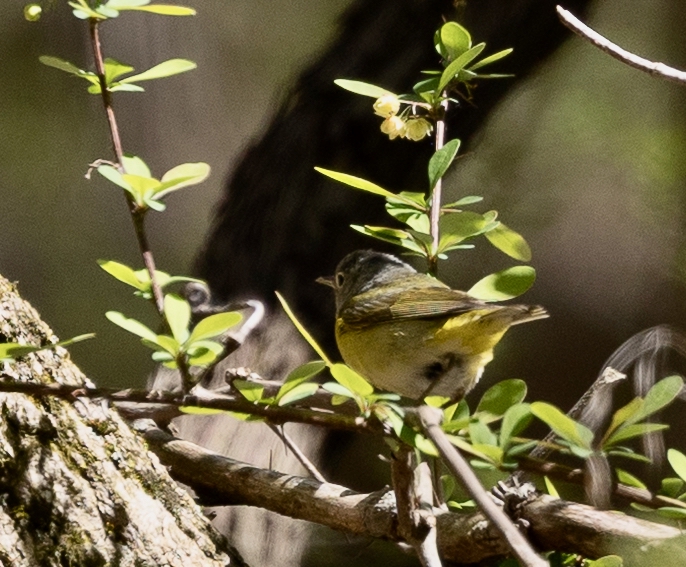
    We caught sight of Blackburnian and Magnolia Warblers, a Ruby-crowned Kinglet and a shy Swainson’s Thrush, but not long enough for good photos. Veerys again made an appearance. Our lunchtime bird this day included an Eastern Phoebe.
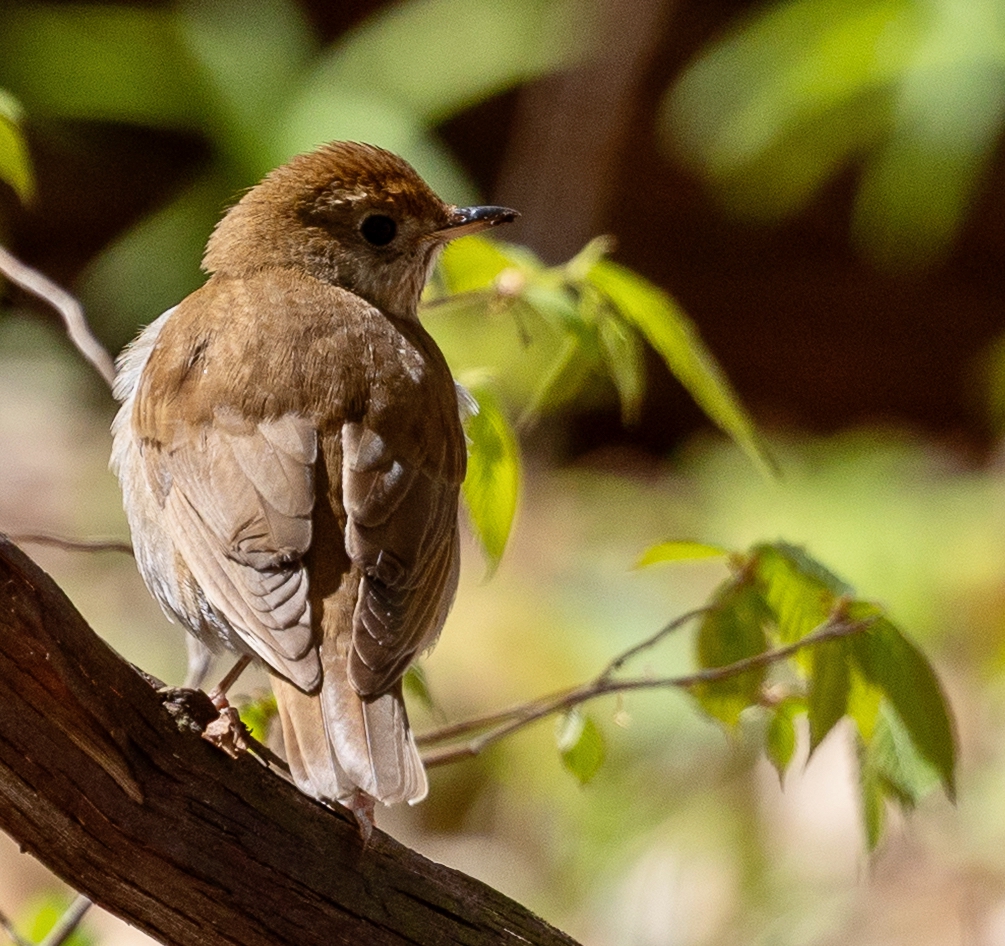
    Many of Rondeaus trails travel through woodland slough or swamp. These watery woods attract several species of birds.

    White-throated Sparrows foraged under the damp leaves.

    We often see Common Grackles foraging along river banks or in wet wooded areas. Although they can be a nuisance in residential areas, there is no denying how splendid their plumage is.

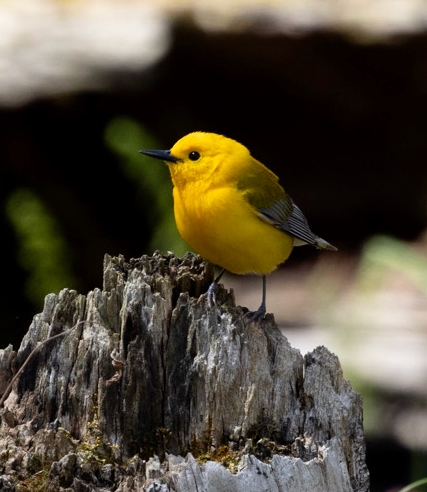
    Prothonotary Warbler

    The most sought-after bird along the Tulip Trail is the Prothonotary Warbler, an endangered species in Canada. The park is one of only two locations in Canada where these birds breed. According to Cornell’s “All About Birds” website, Prothonotary Warblers breed in flooded bottomland forests, wooded swamps, and forests near lakes and streams that are at least 250 acres in size. They winter in eastern coastal areas in South and Central America, Mexico and the southern US. They arrive in Ontario in late April to early May and nest in holes in dead trees or nest boxes, usually near or above standing water.

    We had travelled the Tulip Trail several times over our days at Rondeau without a sighting. On our final day there, with our energy flagging, we decided to sit quietly and wait in the area that is often frequented by the warblers. Our wait was rewarded as we first heard and then saw the approach of a bright saffron male. We later caught of glimpse of a female in the far distance. Passersby stopped to watch as the male spent several minutes exploring the area below the boardwalk. We were able to pass on some information about the significance of the birds and their presence at Rondeau.

    It was a perfect way to end our time on the Rondeau trails!

    Osprey Update

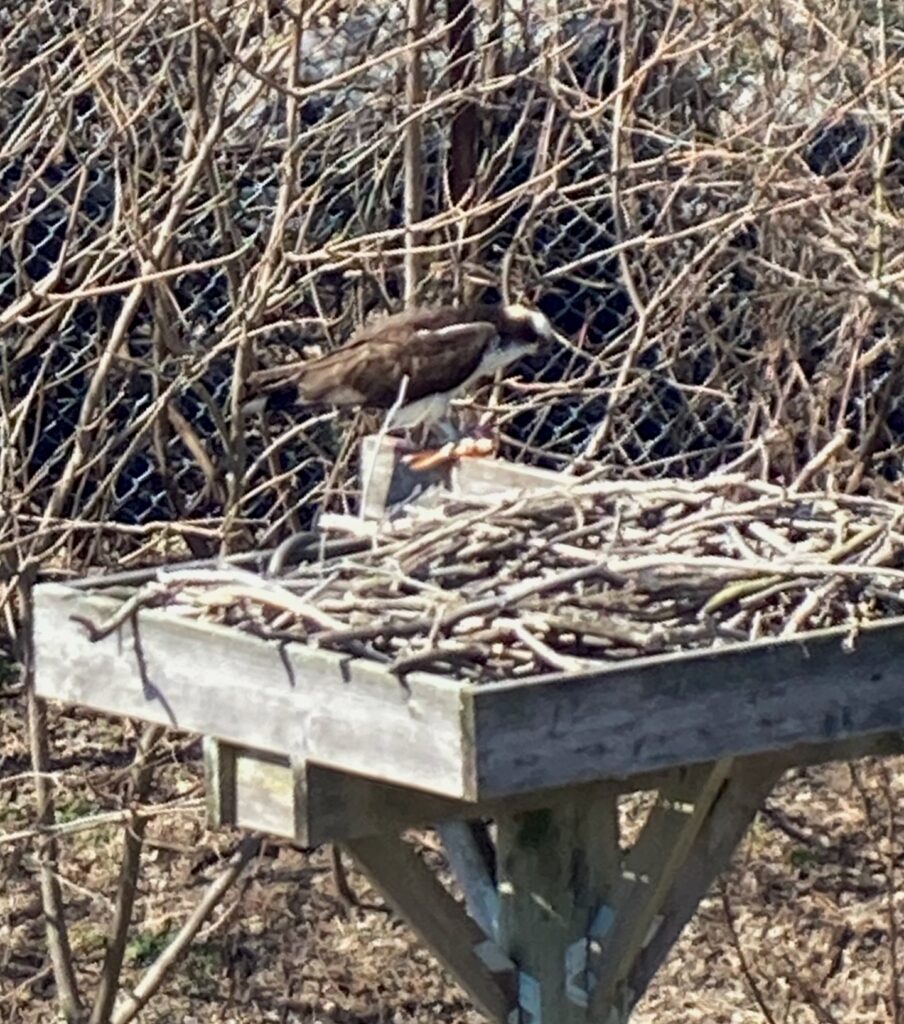
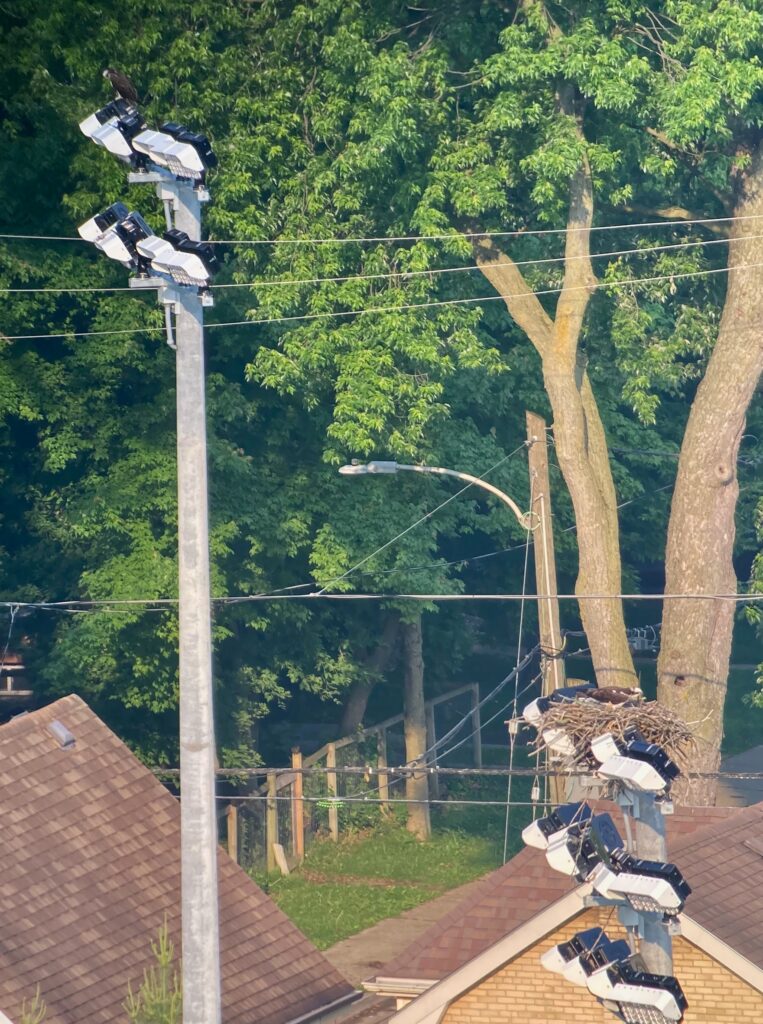
    The Ospreys have remained on the nest through wildfire smoke, heavy rain, and flood-lit evening baseball games with blaring music and announcements. We still are awaiting evidence of young being fed on the nest. To date, the pair continues to take turns on the nest. The male regularly delivers fish and remains close by when he’s not out fishing. Here are the two on adjacent light towers.
    This short video shows the male preparing a fish for delivery to the female.

    Peonies!

    Peonies have been late in blooming in this year’s cool spring. They have finally arrived in the cut flowers from the Wandering Bee and in the gardens at Eldon House. No, they are not native…

    Woodstock

    While Woodstock was the joyous music event in 1969, the year ended rather sadly with the stabbing at a Rolling Stones concert at Altemont.

    Here is my playlist for Woodstock.

  • Rondeau Wildflowers – May 10 & 11, 2025

    Rondeau Wildflowers – May 10 & 11, 2025

    On May 10th and 11th, we spent two glorious spring days under blues skies at Rondeau Provincial Park. When we want to see wildflowers, we head the Spicebush Trail. Its path travels through marsh and Carolinian forest that offer a range of habitats for wildflowers.

    In spring, the water is strewn with Yellow Water-Crowfoot blossoms.

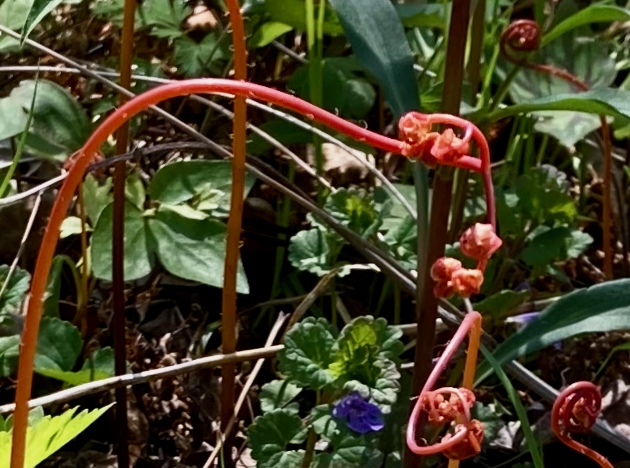
    On one stretch of path we came across unusal red stems with tangled ends emerging from the forest floor. We had no idea what they might be and neither did iNaturalist.

    We appealed to our friends who have wildflower expertise and they solved the mystery. These are the early shoots of Northern Maidenhair ferns. We had only seen these ferns in leaf. Here’s a photo from two years ago.

    In other years, spring has been more advanced and we often miss seeing Dutchman’s Breeches in bloom.

    It was the first time we had noticed the seed pods on the plants. According to Wikipedia, the seed capsule splits in half when the seeds are ripe. Each seed has a fleshy structure, called an elaiosome, that contains protein and lipids that attract ants. The ants take the seeds to their nest, where they eat the elaiosomes and put the seeds in their nutrient-rich nest debris where they germinate. Both the ants and the plants benefit from this relationship. The ants gain a source of food, and the plants are dispersed to new locations by the ants. How cool is that?

    Wood Anemone

    Violets – Common Blue Violets, Long-spurred Violets, Smooth Yellow Violet, Downy Yellow Violet

    And more in bloom…

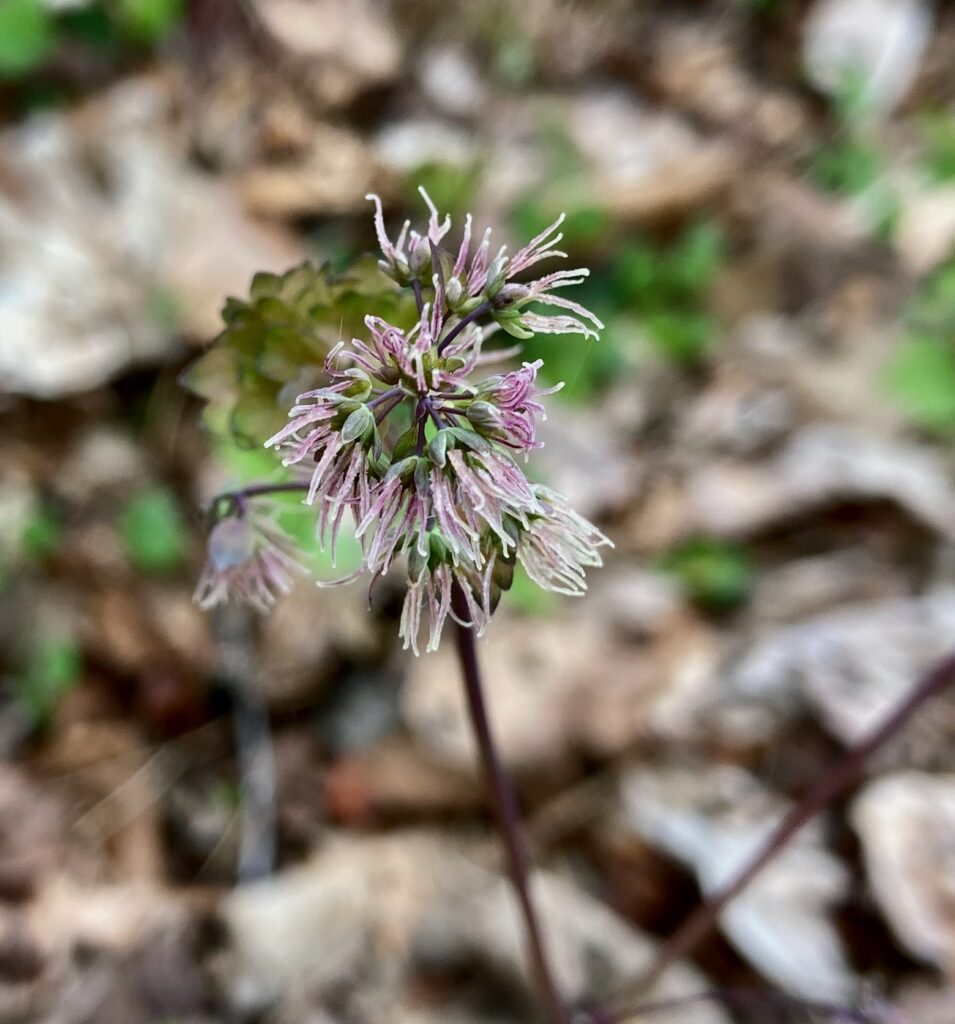
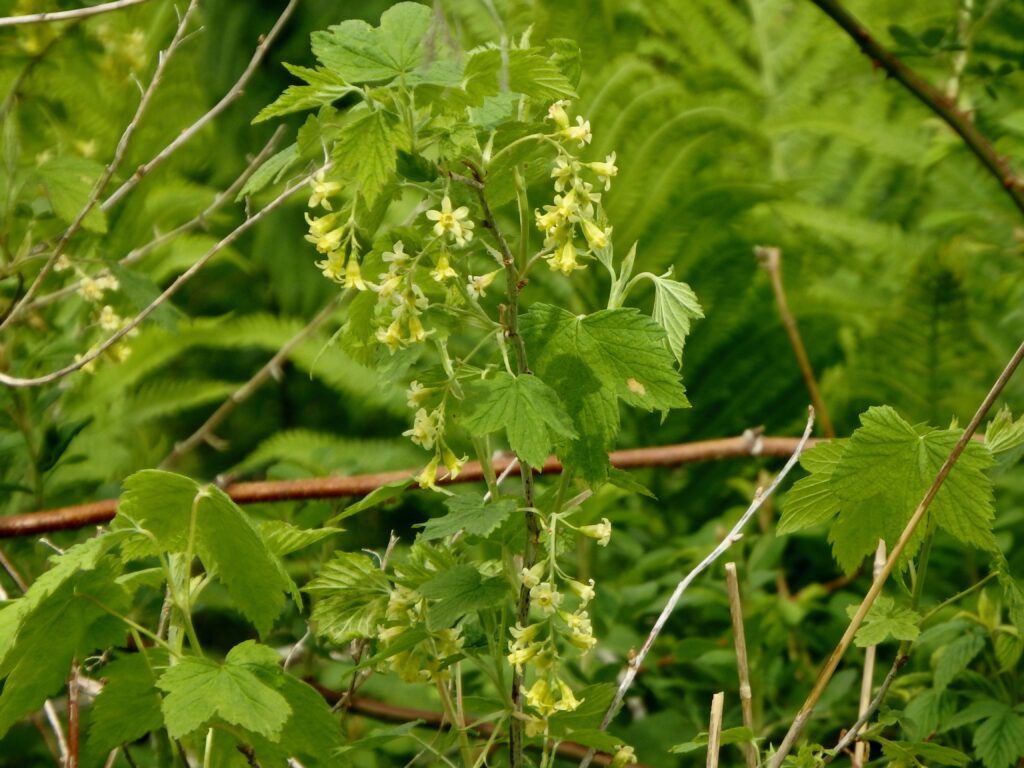
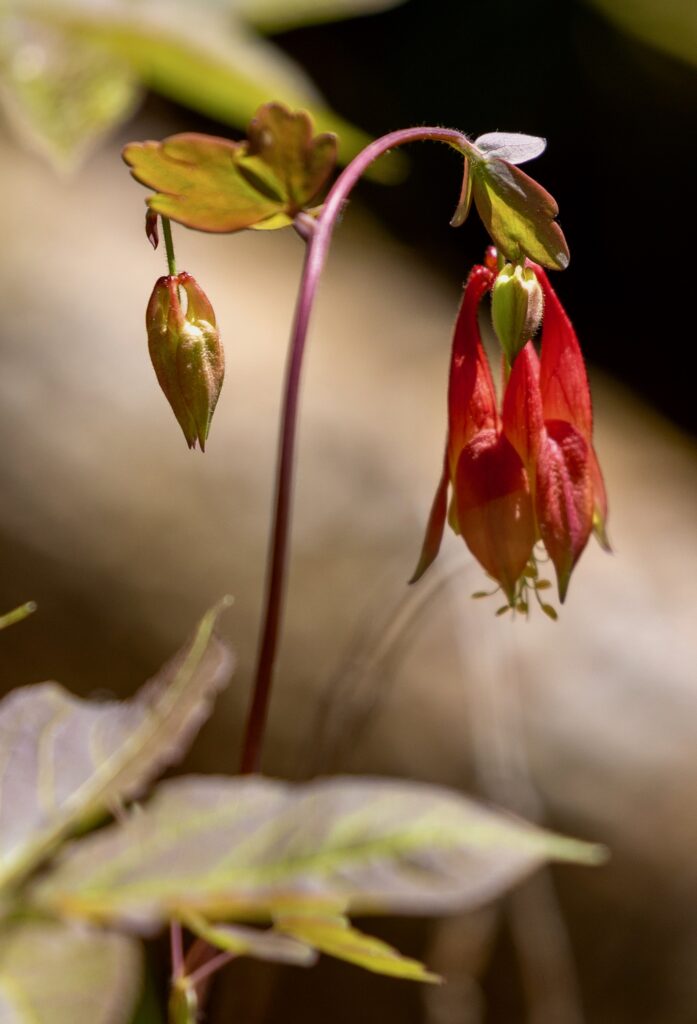
    American Black Currant, Red Trillium, Large White Trillium, Blue Phlox, Early Meadow-Rue, Wild Geranium, Tall Thimbleweed (not in bloom, last year’s blooms gone to seed), Cypress Spurge (introduced from Europe), Goldenseal, Lyreleaf Rockcress, Twoleaf Miterwort, Early Buttercup, Red Columbine.

    Some trees…

    Blue-beech is also known as American hornbeam, ironwood, musclewood and muscle beech due to its strong, dense wood (that feels like metal) and the wavy, muscle-like ridges along its trunk. The tree typically grows in the understory of deciduous forests in rich, moist soils. It is native to eastern North America, including southern Ontario and southwest Quebec in Canada.

    The Carolinian zone in southern Ontario has warmer year-round temperatures than any other part of Ontario. The climate supports ecosystems found nowhere else in Canada. The Tulip Tree is a species specific to the Carolinian zone. They are fast growing and, under the right conditions with a lot of moisture in the summer, reach a height of 35 m and live to 150 years.

    Black Oak also grows only in southern Ontario, often in sandy soils apart from other trees. They grow to 20 m in height and can live to 200 years.

    Below: Tulip Tree sapling and Black Oak in early leaf.

    Chimney Swifts

    Chimney Swifts are small, dark birds that are in London from late April to early October. They spend the whole day flying high, snatching insects from the air. At night, they descend into large and small chimneys to roost together in pairs or in larger flocks. Their feet aren’t designed for perching and are better suited to clinging to rough vertical surfaces (like the inside of some chimneys).

    We’ve recently been busy helping to count the number of Chimney Swifts spending the night in about 18 chimneys in London, some of which have been monitored for over 20 years. The data that is collected is shared with a provincial database and with a national spring survey that helps inform conservation decisions and contributes to the knowledge of swift population changes.

    Here is a short video from a few minutes of monitoring at one of the chimneys on May 29: https://www.youtube.com/watch?v=Bid9qKsy0_w

    For a more dramatic look at Chimney Swifts entering a chimney, check out this CBC report of Chimney Swifts in a Fredericton, New Brunswick chimney recently:

    https://www.cbc.ca/news/canada/new-brunswick/fredericton-chimney-swift-count-1.7547011

    Osprey update…

    …we’re still waiting!

    This week’s flowers

    Celebrating the Music of 1969

    Now we are really getting somewhere. This is the music I listened to loud and daily.

  • Hawk Cliff and Blenheim Lagoons – May, 2025

    Hawk Cliff and Blenheim Lagoons – May, 2025

    Last week we had days of unseasonably cold, overcast and rainy weather. On the one sunny day, our friends suggested a trip to Hawk Cliff where they had recently seen many birds. Hawk Cliff Woods is a 230-acre property stewarded by the Thames Talbot Land Trust. In addition to the extensive woodland, there is an open field, a native plant seed garden and a viewing platform used during the fall hawk migration.

    Here is a view of the road lined with trees and bushes that include a massive Sugar Maple and Quaking Aspens.

    Because the trees are now covered with leaves, we spent time on the more open trails near the garden and along the road. Since we could hear a lot of bird song, we decided to watch and wait for at least some of the birds to pop out from the cover of the leaves. We had success in photographing a few of the 22 species we identified. We missed the Pileated Woodpecker that flew off just as we arrived, although we heard it drumming throughout much of our visit. We heard a Wood Thrush repeatedly, a species that is known to nest in the woodland.

    Yellow Warblers were nesting and busy feeding young.

    Our friends spotted an American Robin sitting on a nest high above us.

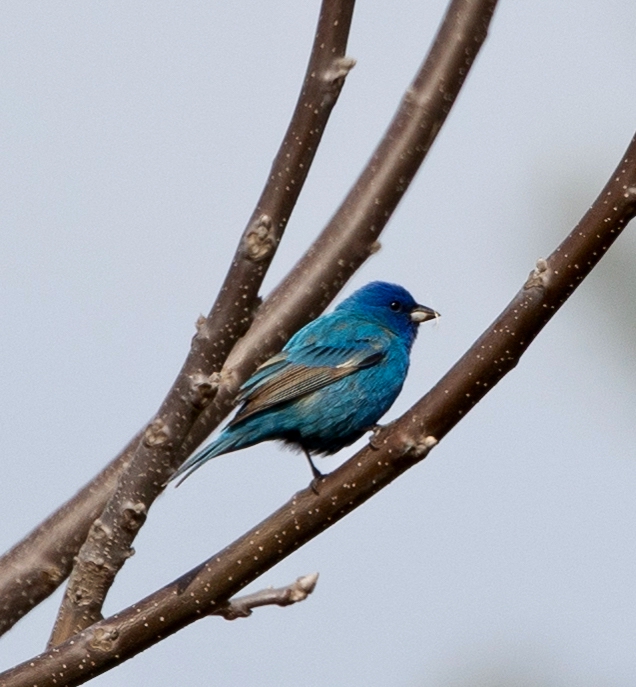
    We are always thrillled to see male Indigo Buntings in breeding plumage.

    A male Baltimore Oriole sang and put on a show in this Eastern Black Walnut tree.

    A few record shots of other species: Gray Catbird singing, Great Crested Flycatcher, Warbling Vireo, Brown-headed Cowbird, juvenile Bald Eagle.

    The Hawk Cliff property overlooks Lake Erie, just to the east of Port Stanley. Bank Swallows burrow into the sandy soil of the cliffs to create their nests. These photos were taken through the fencing that prevents access to the cliff edge.

    When we weren’t watching for birds, we were taking in the wildflowers in bloom.

    Wild Geranium

    Field Horsetail had taken over the field…

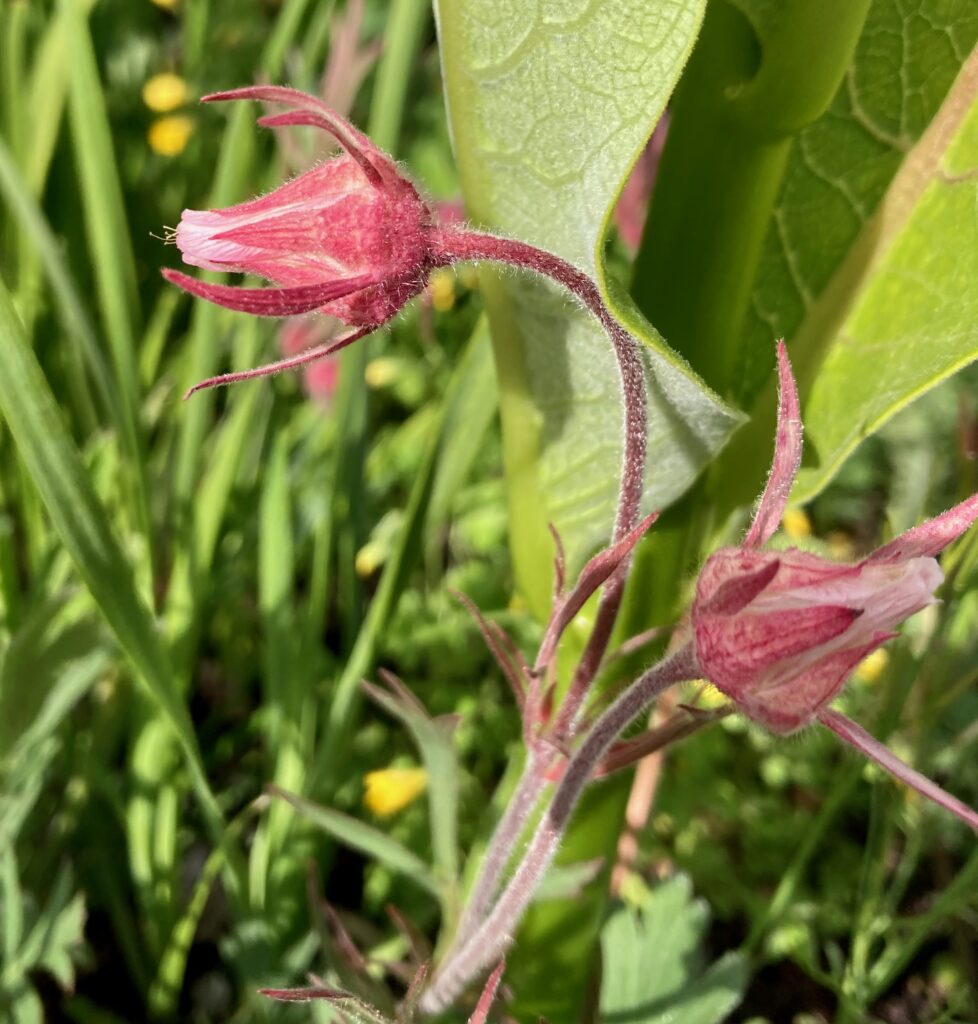
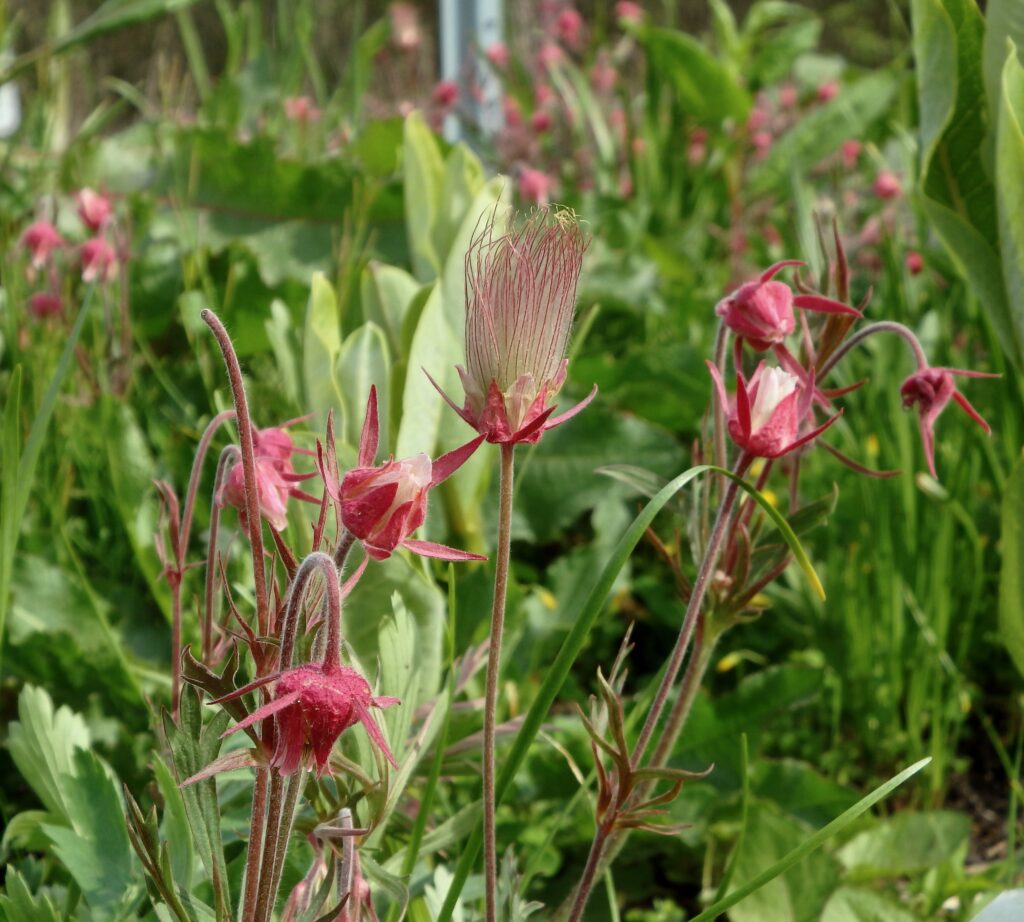
    Prairie Smoke was growing in the wildflower seed garden. We had not seen it in bloom before. It is native to western North America, but there are isolated populations in Ontario. The name derives from the seed heads that have long, feathery plumes that aid wind dispersal of the seeds.

    Star-flowered/False Solomon’s Seal

    Mayapple was in bloom. Mayapples grow in colonies from a single root that sends up several stems. Blossoms develop only on stems with more than a single leaf. The green, yellow or red fruit develops over the summer.

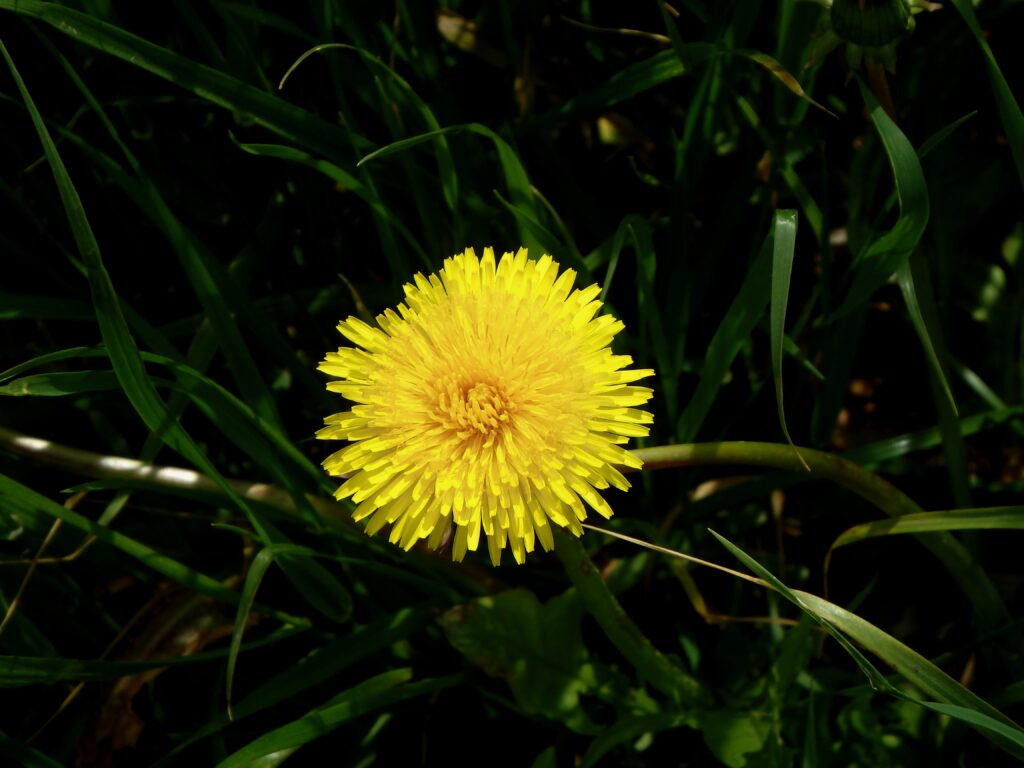
    More blooms: Virginia Strawberry, Scarlet Hawthorne, Dandelion, American Black Currant, Bitter Wintercress

    Blenheim Lagoons – May 9, 2025

    The Blenheim Sewage Lagoons are noted as a birding hotspot. On the windy afternoon of May 9, we explored the ponds, the settlement areas and the grassy fields for migrating waterfowl and shorebirds. Purple Martins, Tree Swallows and a few Rough-winged and Cliff Swallows soared over the ponds, scooping up insects.

    Most waterfowl had moved north to their breeding grounds, but there were a few lingering Ruddy Ducks, Lesser Scaup and Buffleheads.

    There were only a few shorebirds foraging in the shallow water at the edges of the ponds. Among them, much to our delight, were a pair of Wilson’s Phalaropes. These are the first of this species we have seen! We’ve learned that the breeding plumage of female phalaropes is more colourful than that of the males. Wilson’s Phalaropes breed largely in western Canada and the northwestern United States. There is also a breeding population around the southern Great Lakes.

    The phalaropes were in the company of Greater and Lesser Yellowlegs.

    There were a few songbirds among the 20 species we saw that afternoon: female Red-winged Blackbird, Yellow-rumped/Myrtle Warblers, Savannah Sparrow.

    Osprey Update

    We are watching closely, but there is still no sign of young on the nest. The male is frequently perched on the low platform and visits the nest with fish or to replace the female on the nest.

    We were happy to catch this video of the male delivering a fish and then taking the female’s place on the eggs. She took the partialy eaten fish to the low platform.

    More Poppies!

    It was another glorious week of poppies, ranunculus, tulips and Solomon’s Seal to brighten our days.

    Music Overload From 1968

    There was too much for me to choose from. I did not want to cut any of it from this playlist.

  • A Neighbourhood Walk – May 16, and Rondeau – May 8, 2025

    A Neighbourhood Walk – May 16, and Rondeau – May 8, 2025

    It has been cool and rainy most days recently. We are enjoying the colours of the spring canopy that range from chartreuse, to lime, to spring green, but also features the purplish red or maroon of some red maples.

    Last Friday on the one day the sun was shining, we took a brief walk along a wooded path beside the river in Harris Park.

    There was birdsong all around us, some we recognized, and some we couldn’t distinguish in the cacophany of sound and background noise. There was the constant squabbling of Canada Geese that are now shepherding goslings around the neighbourhood, the calls of Red-winged Blackbirds, and the chirping of House Sparrows. Pairs of Northern Cardinals darted across the path, staying in contact with sharp chip calls. Just off the path, a Northern Flicker hunted for insects on the ground. Down the slope, two Gray Catbirds foraged in the fallen leaves where American Robins were also searching. Later a catbird treated us to its repertoire of mimicked calls. We heard the repeated raucous call of a Red-bellied Woodpecker and finally spotted it peering into what appeared to be nest hole high up on the trunk of a tree. We heard, but didn’t spot a Yellow Warbler. Merlin, the bird identification app, suggested that there were several other species present, including other warblers, but we could not confidently distinguish them.

    We were most excited to hear the unmistakable song of a Wood Thrush deep in the trees. Wood Thrush numbers are in decline. These thrushes are considered a species of “special concern” in Ontario. We doubt that the pocket of trees in this local park is large enough to support nesting Wood Thrushes, but the presence of the thrush, even temporarily was very welcome.

    The birds are in their finest breeding plumage at this time of year.

    Male cardinals

    Female Northern Flicker and female Rose-breasted Grosbeak, male Mallard

    Male Red-winged Blackbirds do not attain their full black plumage with red and yellow shoulder patches until they are two to three years old. Non-breeding males tend to look scaly and have incomplete red shoulder patches. Female redwings reach maturity when they are one year old.

    American Robins have already hatched the first of their broods. American Robins are a type of thrush, but only the very young have the spotted breasts of most other thrushes. This young one is probably waiting to be fed by adults.

    Lilacs introduced by European settlers, Dryad’s Saddle fungus

    Rondeau Provincial Park – May 8, 2025

    On May 8th, we spent our first chilly spring afternoon at Rondeau. We can never resist stopping briefly at the Purple Martin houses on our way through the park. Many residents in the area have erected martin houses along the lake shore. It is common to see martins in flight, especially over bodies of water.

    The trees were just beginning to leaf out. Rondeau is often slightly behind London as its proximity to the lake keeps the temperatures cooler in the early spring.

    Large White Trilliums, Cut-leaved Toothwort, Early Meadow-Rue and Smooth Yellow Violets were in bloom.

    Red Columbine blossoms were not quite open. Virginia Creeper was just emerging in some places.

    Birds were relatively quiet that afternoon, apart from a Rusty Blackbird that called repeatedly at close hand. We finally discovered it directly above our heads. The population of Rusty Blackbirds is in sharp decline. This one will migrate farther north before nesting in wet woodlands, fens, bogs, muskeg, and beaver ponds. Note the blackbird’s pale eye. Non-breeding males are dark brown with rusty edges on their feathers.

    A Nashville Warbler foraged high in a tree, moving rapidly as most warblers do. In contrast, this Black-thoated Blue Warbler was uncommonly still, allowing for good photos and good views.

    This pair of Rose-breasted Grosbeaks were high in the trees and not easy to photograph. They may stay to breed in the park or go slightly farther north.

    Osprey Update

    We are keeping watch for any sign of young being fed. So far, the male has stayed close by and the female remains low on the nest, keeping the eggs warm and dry.

    This Week’s Flowers

    Double pleasure. Two bouquets came home last week, thanks to a gift from Dan of the Wandering Bee flower farm. The poppies have been a bright addition to an often gloomy week.

    More music from 1967

    Starting with 1967, I will spread my music from that year over more than one post. By 1967, I was buying albums from time to time. Here are my favourite 10 from the top 30 for 1967.

    As the last song says, “Ah, but I was so much older then. I’m younger than that now.”

    About the final video (from Wikipedia):

    At the 30th Anniversary Tribute Concert to Dylan at Madison Square Garden in 1992, “My Back Pages” was performed in the Byrds’ arrangement, with Roger McGuinnTom PettyNeil YoungEric Clapton, Dylan himself, and George Harrison, each singing one verse in that order.[4] This performance, which included guitar solos from Clapton and Young, also featured Jim Keltner, G. E. Smith, and the three surviving members of Booker T. & the M.G.’s (Steve CropperBooker T. Jones, and Donald “Duck” Dunn) as sidemen.[12] It was released on The 30th Anniversary Concert Celebration album in 1993.[12]

    My Back Pages

    Written by: Bob Dylan

    Crimson flames tied through my ears
    Rollin’ high and mighty traps
    Pounced with fire on flaming roads
    Using ideas as my maps
    “We’ll meet on edges, soon,” said I
    Proud ’neath heated brow
    Ah, but I was so much older then
    I’m younger than that now

    Half-wracked prejudice leaped forth
    “Rip down all hate,” I screamed
    Lies that life is black and white
    Spoke from my skull. I dreamed
    Romantic facts of musketeers
    Foundationed deep, somehow
    Ah, but I was so much older then
    I’m younger than that now

    Girls’ faces formed the forward path
    From phony jealousy
    To memorizing politics
    Of ancient history
    Flung down by corpse evangelists
    Unthought of, though, somehow
    Ah, but I was so much older then
    I’m younger than that now

    A self-ordained professor’s tongue
    Too serious to fool
    Spouted out that liberty
    Is just equality in school
    “Equality,” I spoke the word
    As if a wedding vow
    Ah, but I was so much older then
    I’m younger than that now

    In a soldier’s stance, I aimed my hand
    At the mongrel dogs who teach
    Fearing not that I’d become my enemy
    In the instant that I preach
    My pathway led by confusion boats
    Mutiny from stern to bow
    Ah, but I was so much older then
    I’m younger than that now

    Yes, my guard stood hard when abstract threats
    Too noble to neglect
    Deceived me into thinking
    I had something to protect
    Good and bad, I define these terms
    Quite clear, no doubt, somehow
    Ah, but I was so much older then
    I’m younger than that now

    Copyright © 1964 by Warner Bros. Inc.; renewed 1992 by Special Rider Music

  • Erieau Marsh Trail – May 7 & 9, 2025

    Erieau Marsh Trail – May 7 & 9, 2025

    The Greening of the canopy

    The weather was cool and rainy in late April and the first days of May. The leaves were just beginning to unfurl. We then took ourselves away to the shores of Lake Erie for a few days last week for a chance to see spring flowers and migrating birds. Over that time, the weather was sunny and warm. We returned to a much greener canopy.

    April 30

    May 3

    May 14

    Erieau Marsh Trail

    The Erieau Marsh Trail runs along a former rail bed. It overlooks marshland and Rondeau Bay on Lake Erie.

    The nests of Mute Swans were occupied by females incubating eggs. Males stayed protectively nearby in open water.

    Red-winged Blackbirds also nested along the water’s edge.

    The marsh is home to several species of turtles. Below are a Northern Map Turtle (left), Midland Painted Turtles and a Blanding’s Turtle (bottom right).

    Barn Swallows, Tree Swallows and Purple Martins foraged for insects above the marsh and occasionally perched on a convenient branch. Barn Swallows and Tree Swallow (bottom right).

    A small flock of Forster’s Terns circled and dove for fish.

    On the path and in the trees and scrub beside the path, we found a variety of wildlife.

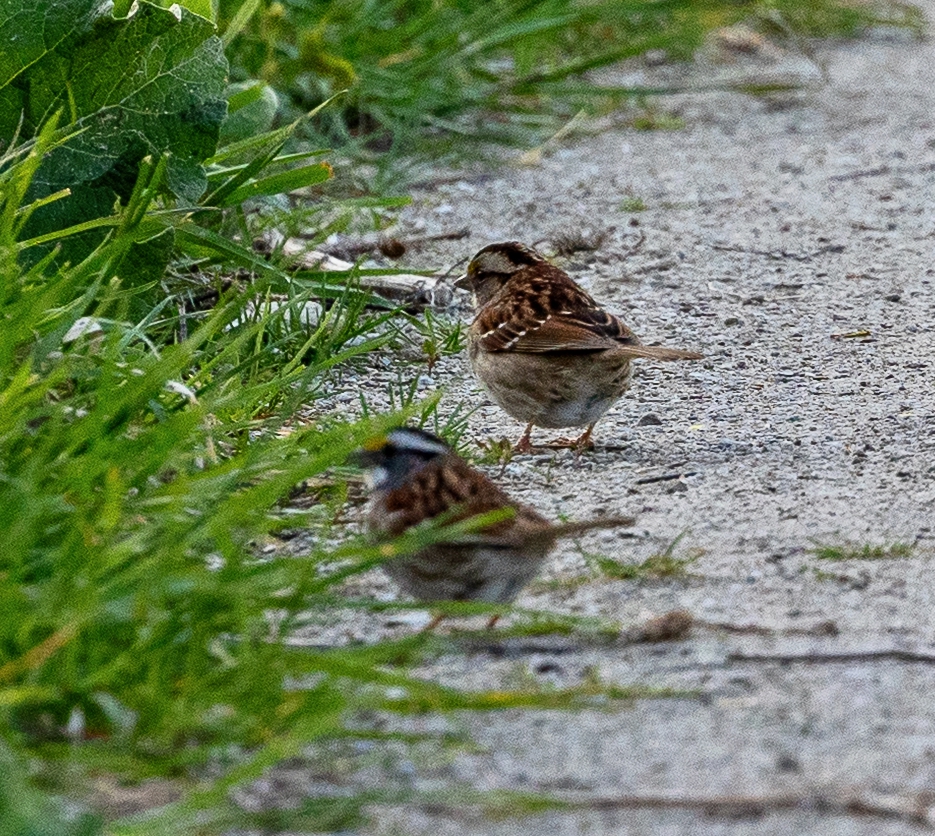
    White-crowned and White-throated Sparrows and a female Northern Cardinal

    In some cultures, the image of rabbit is seen in the face of the moon. We did not see the rabbit in the moon, but In the cool of the evening Cottontail rabbits and an American Toad made an appearance.

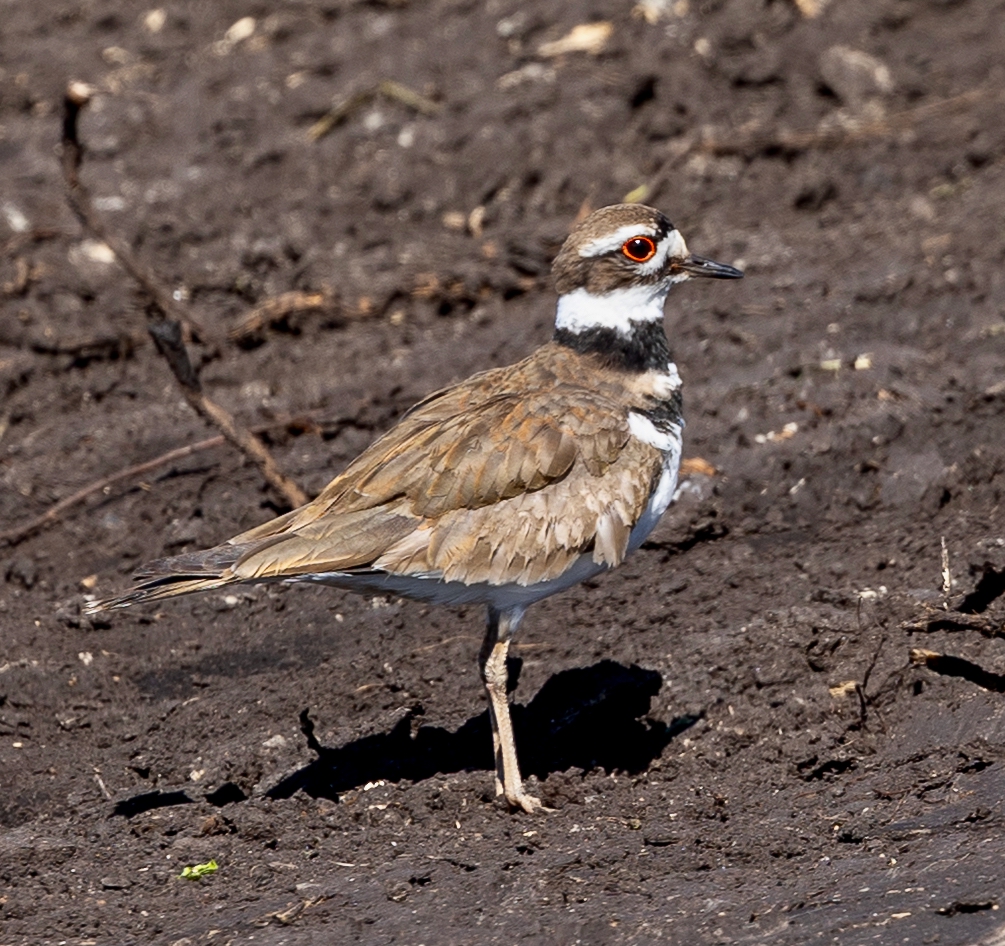
    Killdeer nest in nearby fields and forage on the ground and the mudflats of the marsh for invertebrates (earthworms, snails, grasshoppers, beetles, etc.).

    It was a challenge to photograph warblers high in trees, moving rapidly in search of insects. These are the best of many attempts.

    Black-and-white Warbler and a Magnolia Warbler

    Other birds were elusive, but stayed still a little longer.

    Eastern Kingbird and House Wren

    The nearby McGeachy Pond trail overlooks Lake Erie. Here we saw few birds. This Least Flycatcher hawking for insects from a branch over the water was the highlight.

    Virginia Strawberry (also named wild strawberry or common strawberry) is native to North America. We were sorry to see so much of the trail lined with invasive Garlic Mustard. We looked forward to seeing more native wildflowers in Rondeau Provincial Park.

    Speaking of wildflowers…

    Again thanks to our very knowledgeable friends, we have learned that the Red Trillium has naturally occurring variations in colour that include dark reddish brown, maroon, purple, pale yellow, or white. In our last post about Solitude Nature Reserve, we incorrectly stated, “Red Trilliums fade to a yellow colour as they age.” In fact, the yellow colour we observed is not a function age or maturity.

    Osprey Update

    When we returned from a few days away, we found the female Osprey firmly in place on the nest and male sometimes nearby. The end of the incubation period is near and we expect to see greater activity on the nest soon! We will watch for fish deliveries and signs that the female is feeding newly-hatched chicks. In the meantime, the male is occasionally replacing the female on the nest as seen in this video: https://www.youtube.com/shorts/NXyN7cpUcZU

    Great Music from 1967

    The Beatles dominate this playlist with singles from Sgt. Pepper’s Lonely Hearts Club Band and Magical Mystery Tour. I will have more music from 1967 next week.

  • Solitude Nature Reserve – April 29, 2025

    Solitude Nature Reserve – April 29, 2025

    Solitude Nature Reserve is operated by the Phil McNamee Charitable Foundation as a natural environment for the public to enjoy.

    On an overcast day that was threatening rain, we went to Solitude with friends in hopes of seeing the display of trilliums and other wildflowers before it was too late. We were not disappointed! With four photographers, we had even more photos to choose from…

    Large White Trilliums are sometimes affected by a bacteria that changes the colour of their petals.

    Red Trilliums fade to a yellow colour as they age. They also appear to be affected by a bacteria or virus that can distort their petals and leaves.

    Colt’s-Foot is one of the few introduced species we saw. It may have been used for medicinal purposes by early settlers. It can be invasive.

    Marsh Marigold and Skunk Cabbage grew in abundance in the swampy areas. Field Horsetail was also pushing up.

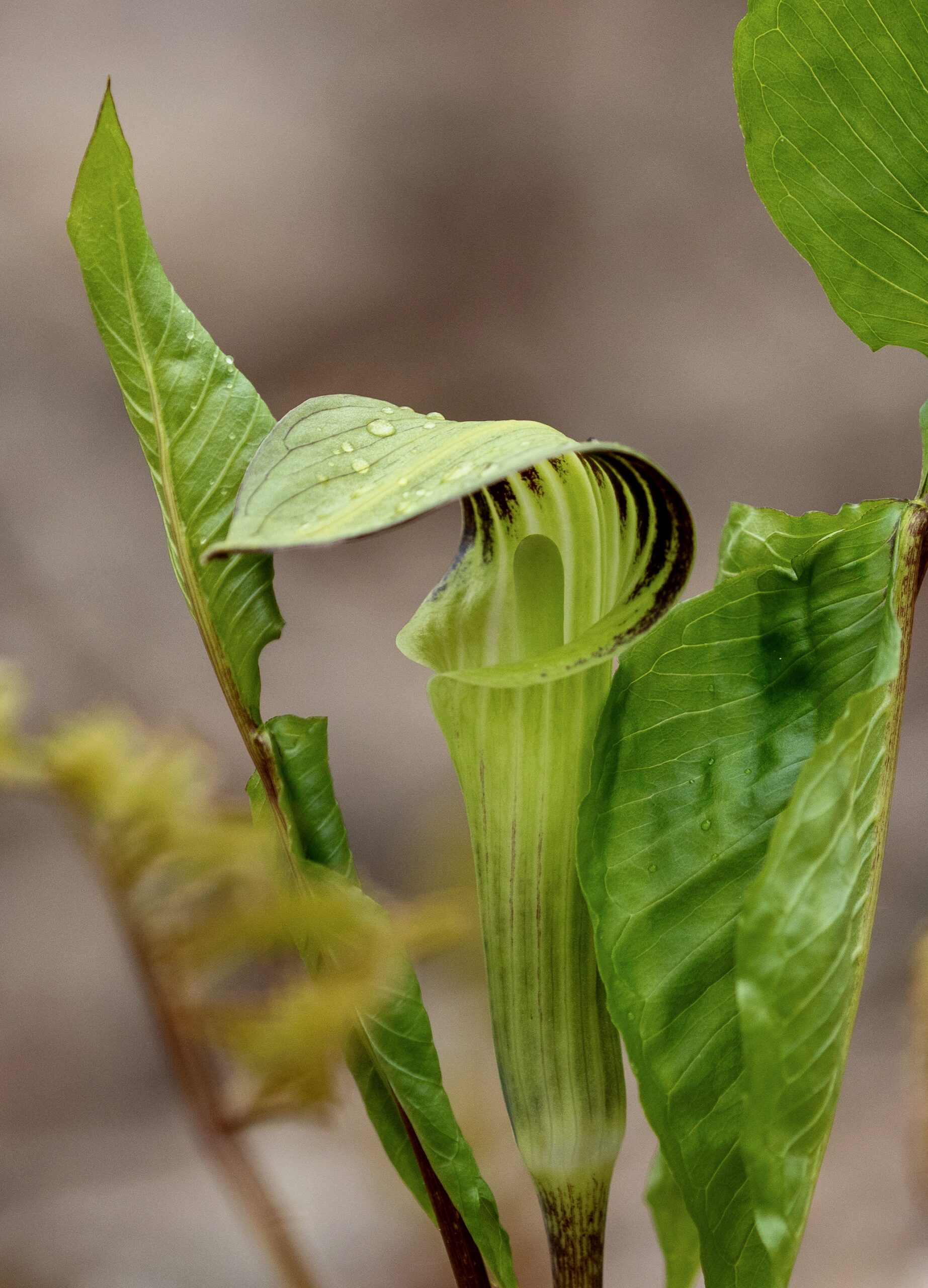
    Jack-in-the-Pulpit is one of our favourite native plants.

    Christmas fern was just unfolding its new fronds.

    At first, we thought this plant was Dutchman’s Breeches, but on closer examination it turned out to be a related, but differnt plant, Squirrel Corn. Dutchman’s Breeches have spurred flowers that are more pointed whereas the flowers of Squirrel Corn are heart shaped.

    There was so much else to see!

    Purple Cress

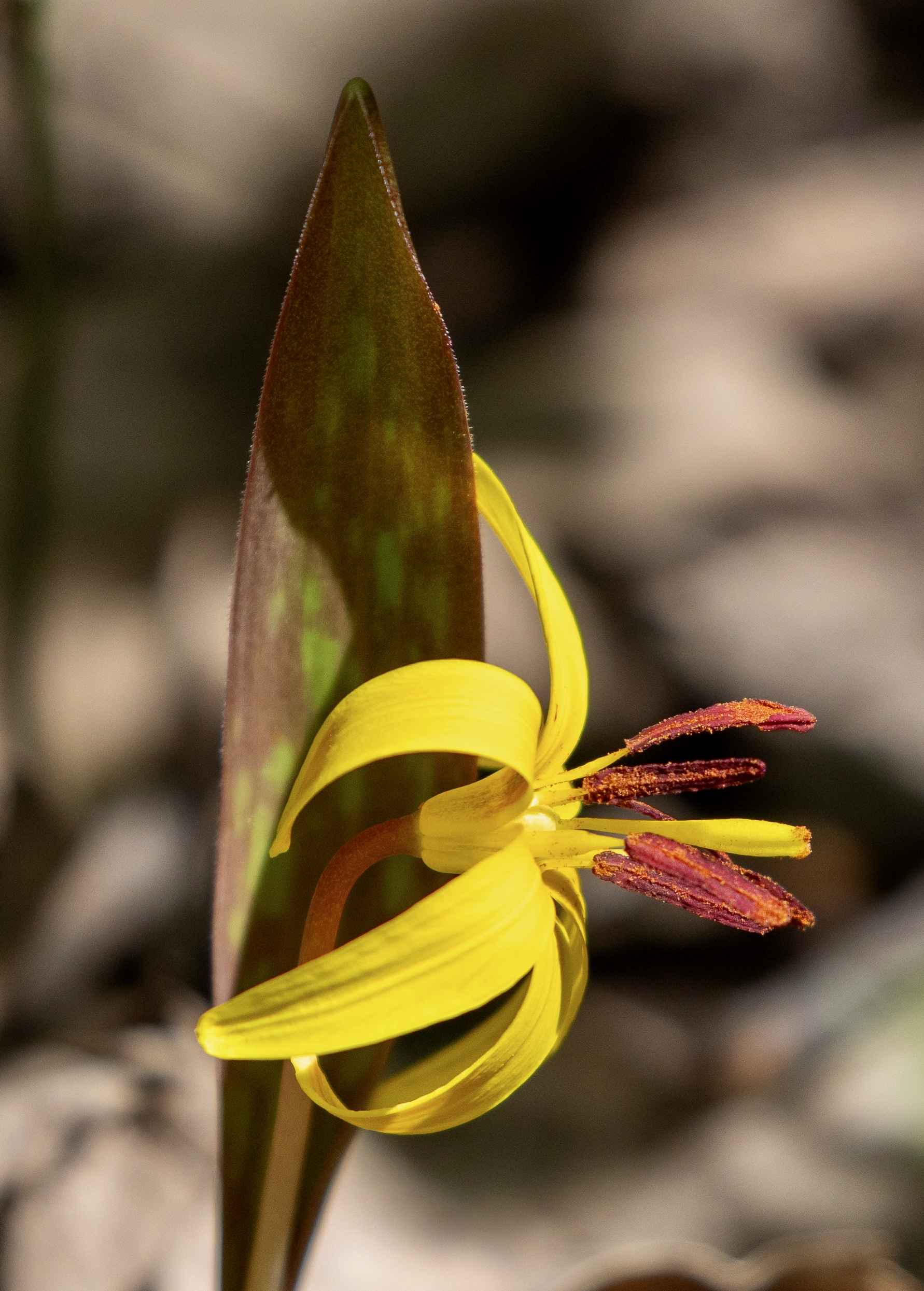
    Yellow Trout Lilies and Virginia Spring Beauty

    Early Blue Cohosh is a native forest plant that was just coming into bloom. It blooms earlier than Blue Cohosh (bottom right).

    Eastern Cottonwood catkins in the water and Turkey Tail fungus.

    Spicebush is a shrub that is native to Ontario, found in moist woods. It has bright yellow flowers in early spring and fragrant leaves. It is noted as a host plant for the Spicebush Swallowtail butterfly.

    As is often the case, we heard many birds, but saw only a few long enough to capture a photo. We counted 12 species. A Grey Catbird mewed and mimicked, but did not show itself. A Yellow Warbler, or perhaps more than one, sang repeatedly from the tree tops, out of sight. We couldn’t locate the Song Sparrow that was singing. We heard the contact chips of White-throated Sparrows that were barely visible as they swept along low branches, close to the forest floor. Several Hermit Thrushes were flying through the forest, landing on low branches. Finally, two photographers got photos! The “parking lot bird” of the day was a Ruby-crowned Kinglet deep in the bushes that our friend was able to photograph (bottom centre).

    Wandering Bee Flowers

    It was hard to decide between poppies or parrots tulips at the Saturday market. The tulips won, but only by a slender margin…

    Great Songs from Great Albums 1966

    Now I am having trouble limiting my selections. There was so much music around that I really liked:

    https://www.youtube.com/playlist?list=PLhsgho1ap5iq6xLxp2i6WebhGqr1_RAuN

  • Coldstream Conservation Area – April 27, 2025

    Coldstream Conservation Area – April 27, 2025

    Spring continues to unfold accompanied by wide swings in temperature and frequent rain. The canopy is gradually being painted with various shades of chartreuse and spring green.

    This week also brought destructive winds and a lashing rain that caused power outages across the city. We were spared as the downtown core’s services are largely underground. The strong winds temporarily replaced the clouds with blue sky.

    Coldstream Conservation Area

    Coldstream is noted for its trail through a rare cedar swamp.

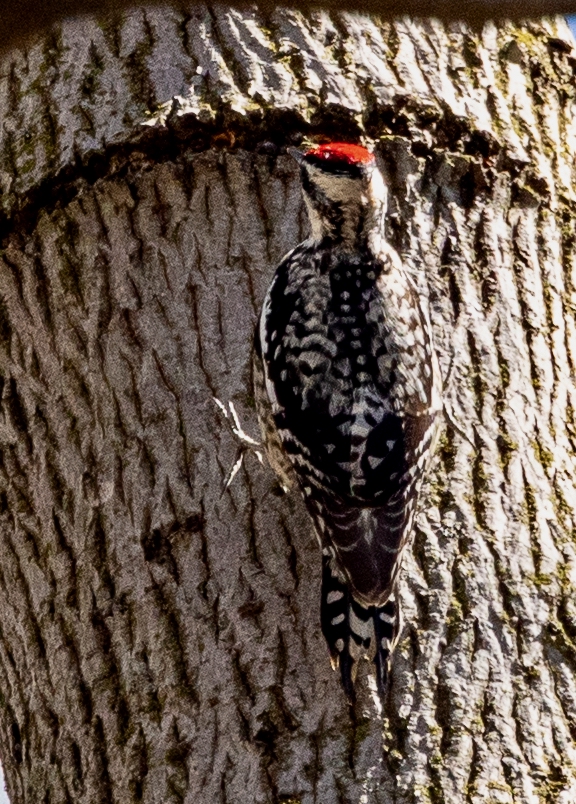
    We counted 10 species of birds. Most were residents or very early migrants that we had seen already this year with the exception of these two that were high on the trunks of tall trees.

    Other wildlife was emerging in the increasing warmth of the spring weather.

    Common Garter Snake

    We came across a variety of insects and a spider, a Multicoloured Bark Crab Spider, not pictured here.

    The main attraction of the conservation area that day was the variety of native wildflowers.

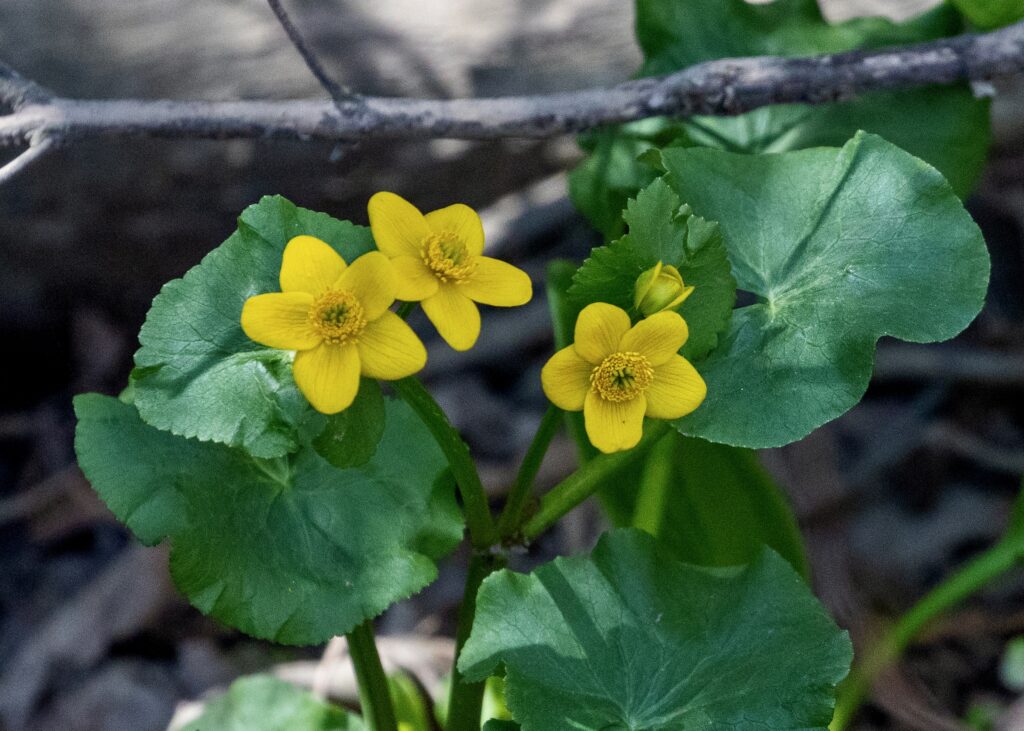
    Marsh Marigolds and Skunk Cabbage grew in abundance in the wet, marshy areas.

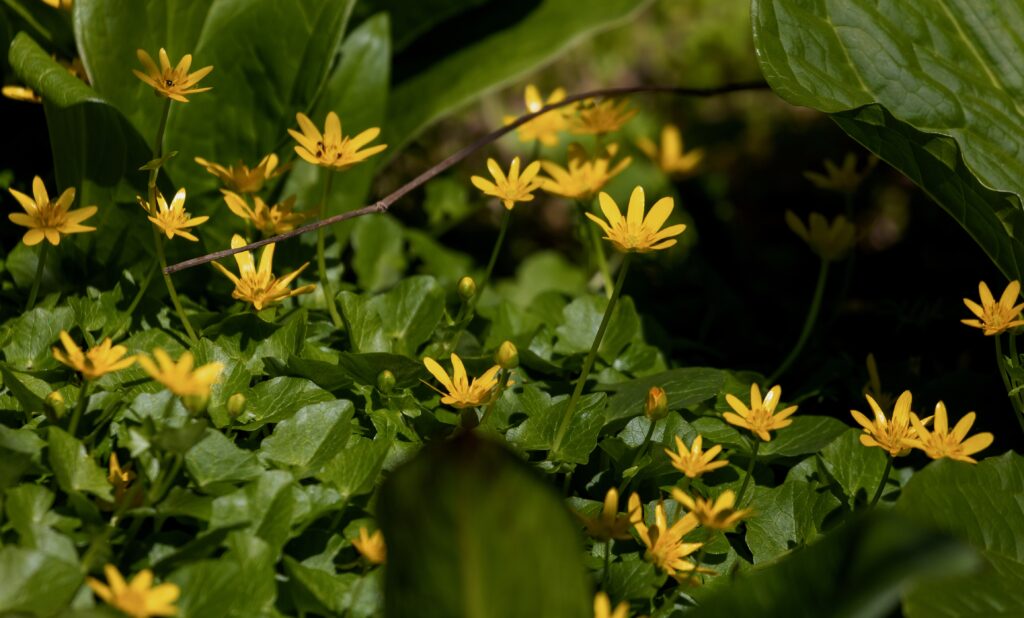
    We are learning to distinguish Marsh Marigolds from Lesser Celandine. Although both are in the buttercup family, Marsh Marigold is a native plant whereas Lesser Celandine is an introduced species that has become invasive.

    Marsh Marigold is found only in wet locations such as swamps or the banks of streams. Marsh Marigolds have five to nine rounded petals and finely toothed leaves. Lesser Celandine usually has eight petals that are more pointed and leaves that are generally smooth or slightly lobed. Lesser Celandine can tolerate drier conditions and tends to form dense mats wherever it grows.

    Mayapples covered the forest floor but were not yet in bloom.

    Yellow Trout Lilies dappled the the ground and white Fawn Lilies sparkled like stars.

    Narrow-leaved/Virginia Spring Beauty was also abundant.

    And even more…

    Red Trillium

    Early Meadow-Rue

    Common Blue Violet

    Cut-leaved Toothwort

    Virginia Strawberry and, probably, cherry blossom.

    Ospry Update

    There is nothing very new to report. The female Osprey has stayed steadfastly on the nest through high winds and rain. We often see the male on the low platform preening. Although we haven’t captured any more fish deliveries on video, we imagine that he is grooming after catching and eating fish. We are counting the days until we expect new life on the nest.

    As we read more about the lives of birds, we are becoming aware that there are individual differences in within each species that can account for differences in behaviour. Birds are not just driven by instinct, but actively learn and adapt in response their experiences. Just like us!

    More Tulips!

    This week’s tulips had happy colours and a delicate, sweet fragance.

    Singles from 1965

    I remember hearing most of these songs on radios in my friend’s cars when there were no adults around to hush my singing or to turn the radio to a different station. This will the last year that is about singles. Starting with the year 1966, I will feature songs from the year’s top albums. Click on the image below to access the playlist on YouTube.

  • Medway Creek and Springbank Park – April 2025

    Medway Creek and Springbank Park – April 2025

    Spring is arriving, albeit slowly this year. We’ve had a few more warm, sunny days as well as wide temperature swings. The trees are still bare, but soon they will be cloaked in spring green.

    Medway Creek

    Medway Creek runs through part of the Western University campus. We took advantage of the free weekend parking on campus to explore a trail that runs along the creek.

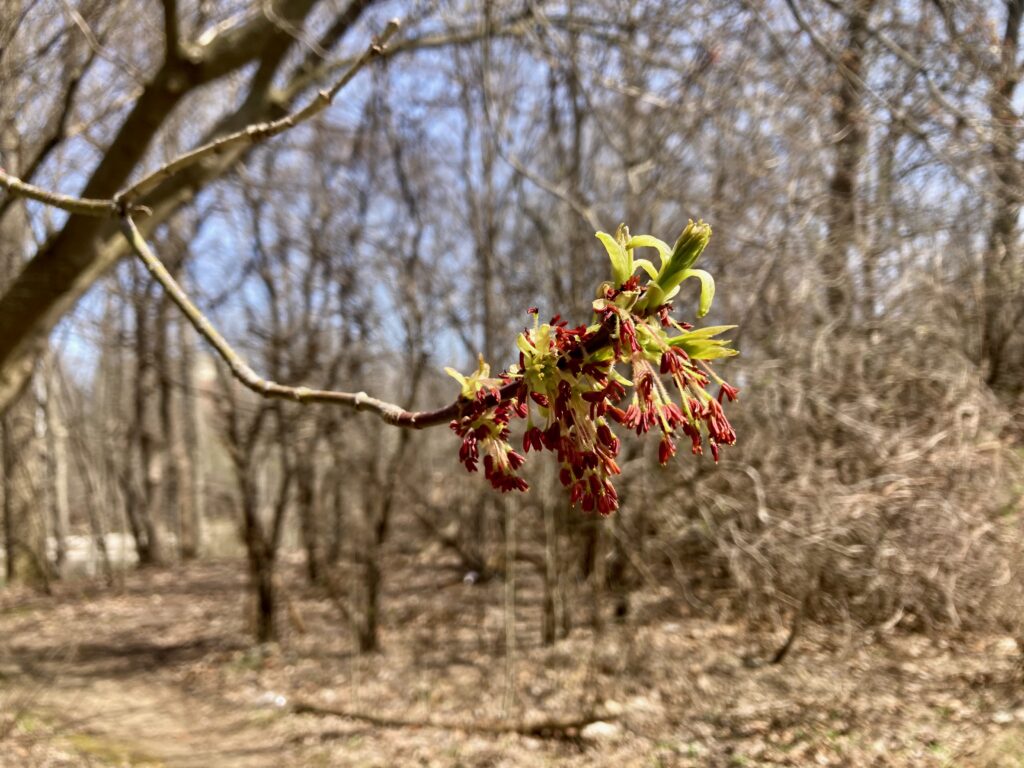
    A few trees were beginning to bloom.

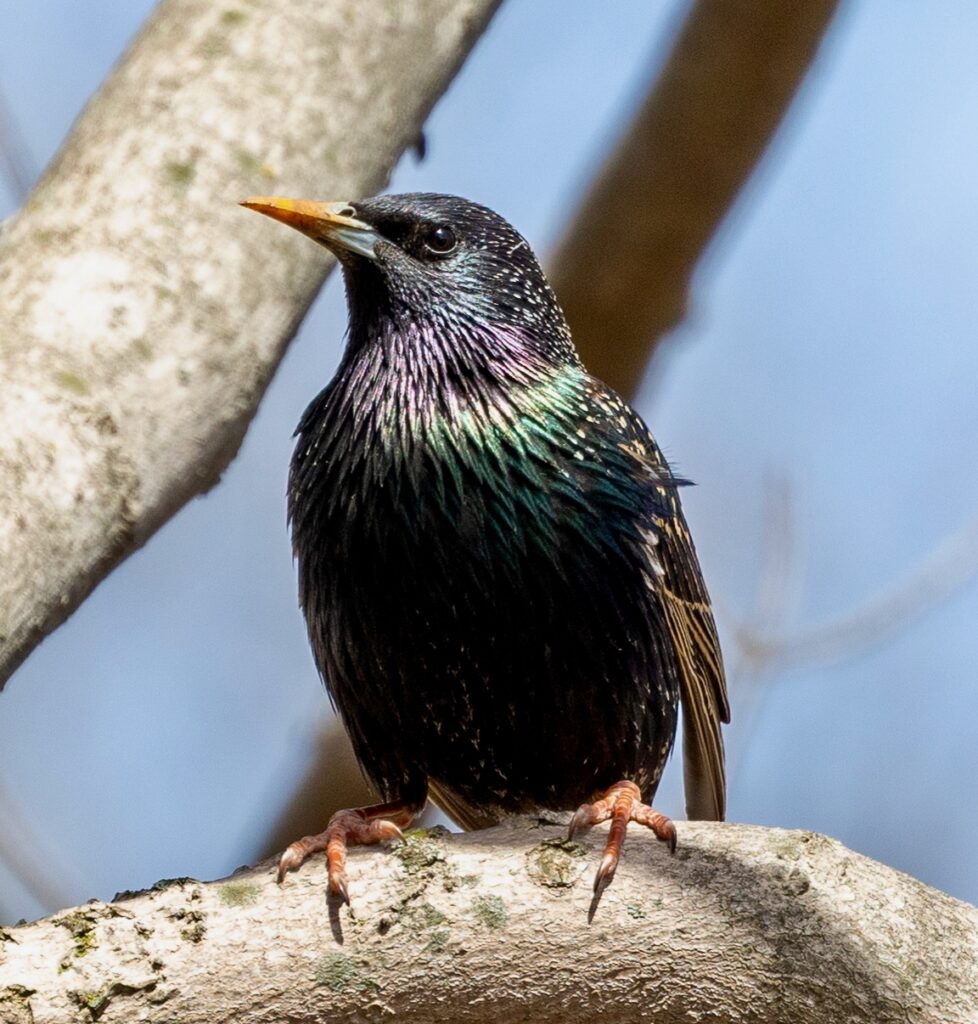
    Our bird list had only 12 species, mostly heard or barely seen high in the trees. Only this European Starling posed for a photo.

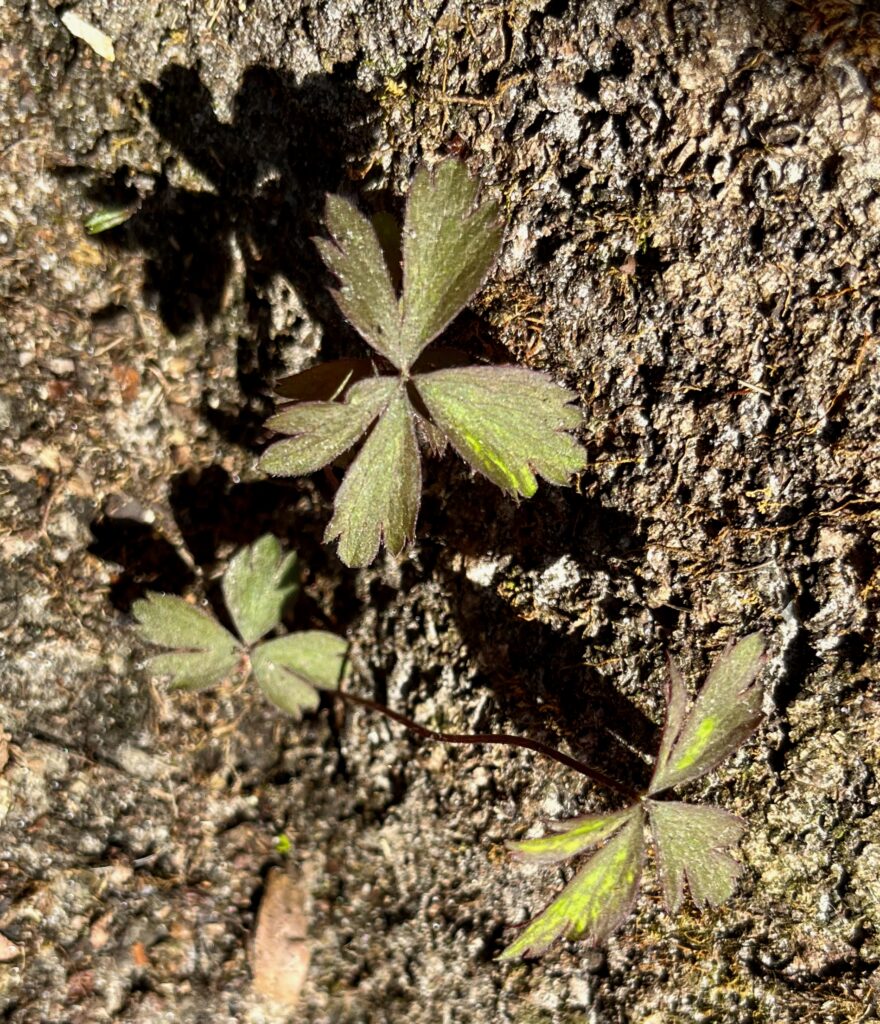
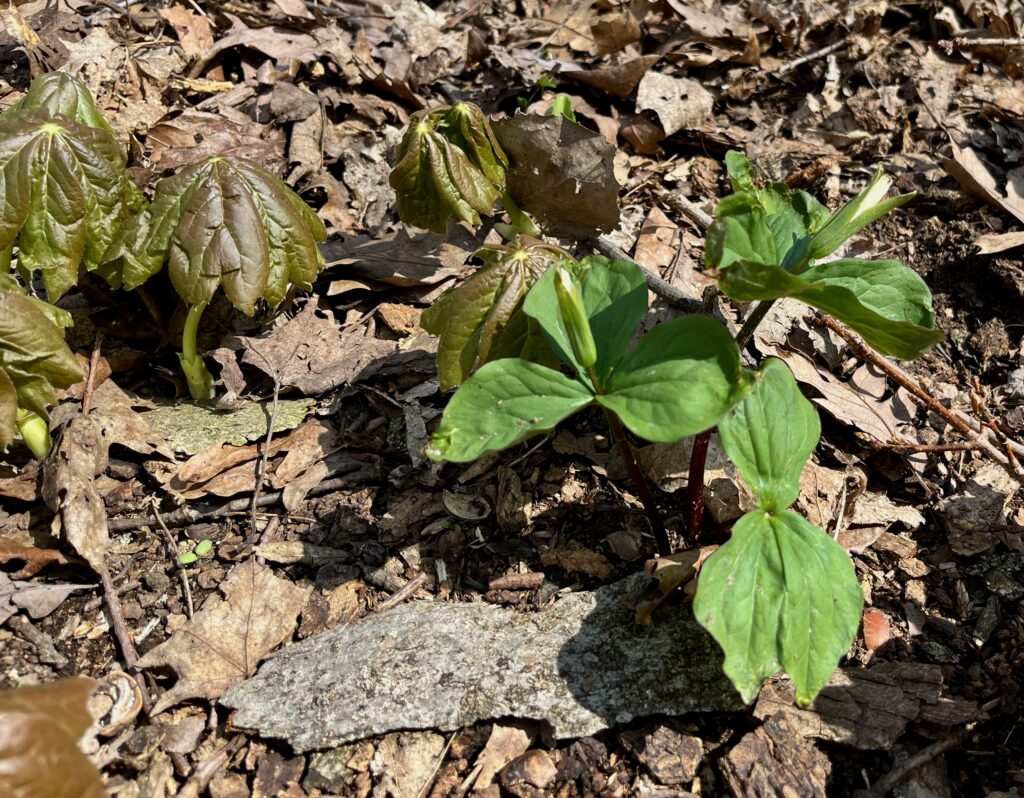
    We were delighted to find a few wildflowers emerging.

    The leaves of Yellow Trout Lilies carpeted the ground in some areas. A few blossoms were starting to open.

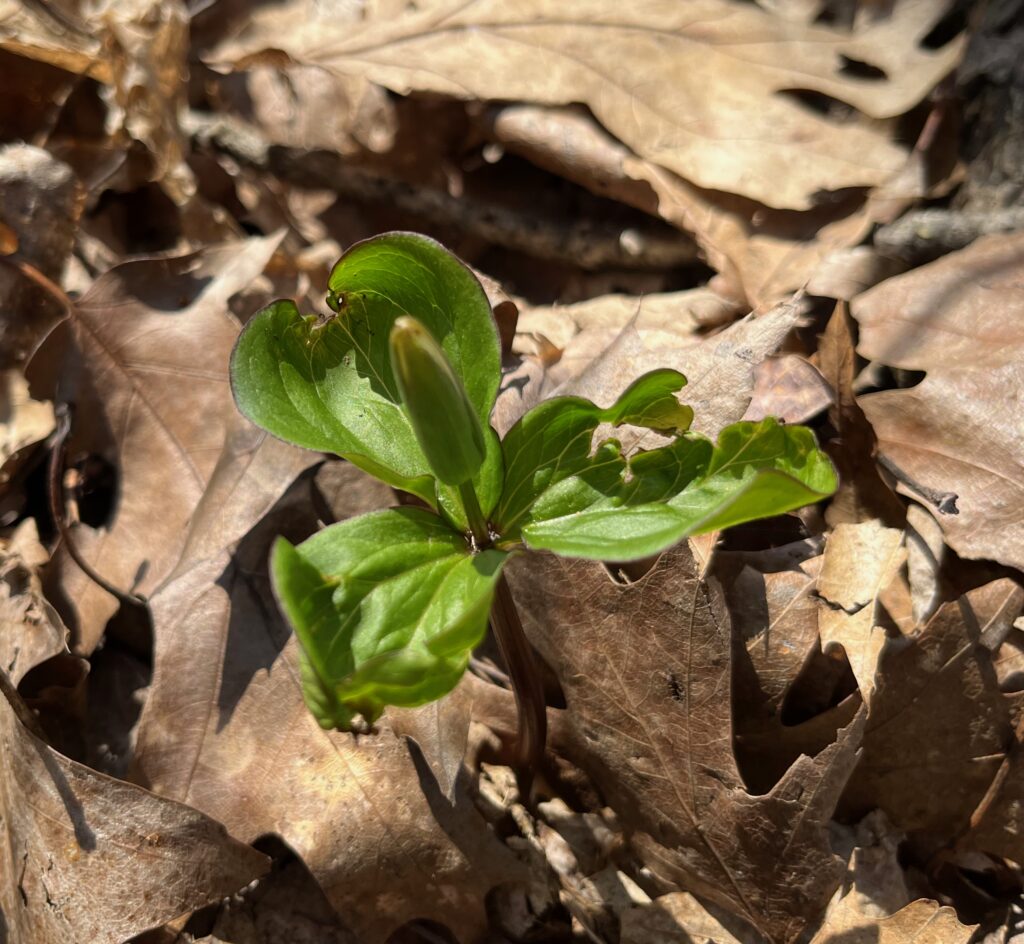
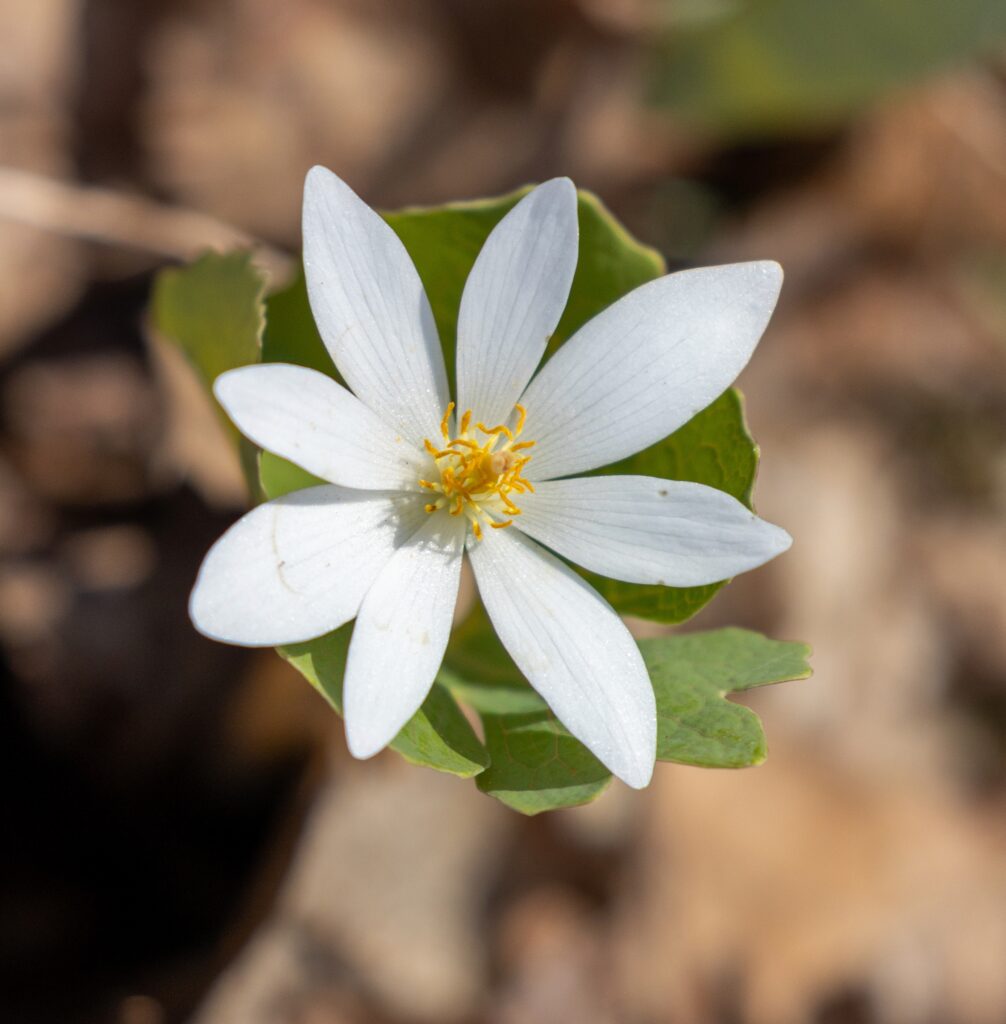
    Patches of Bloodroot were coming up through the carpet of dead leaves on the forest floor.

    Early Meadow-Rue, a native woodland plant suitable for shade gardens was not yet in bloom.

    There were the inevitable introduced species that have naturalized in greater numbers and become invasive in some areas.

    The early blooms attracted a variety of pollinators.

    Storybook Gardens

    On another sunny day, we accompanied friends to see if Bald Eagles were on the nest they had constructed. From the woods overlooking Storybook Gardens, it was just possible to see the unoccupied nest in the distance.

    Native plants were emerging through the leaf litter, not yet fully in bloom.

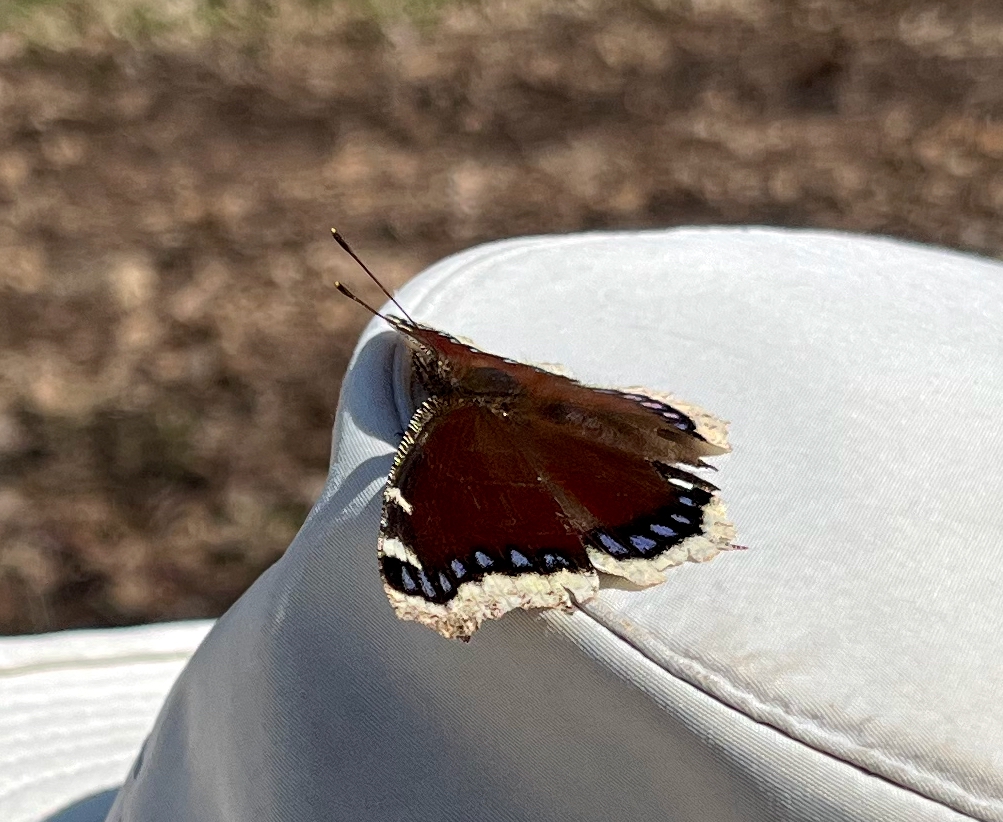
    Besides wildflowers, Mourning Cloak butterflies were emerging in the warmth of the afternoon, ready to start mating. Because they overwinter in tree crevices or under tree bark as adults, these butterflies can look a little the worse for wear.

    Cylindrical Click Beetles were also emerging. Some click beetles are destructive plant pests.

    Our friends’ garden featured a variety of native plants and many visitors to their birdfeeders.

    Correction

    Thanks to a friend, a native wildflower expert, for noticing a mistake in our last post. Even though we remarked on the different appearances of the blue flowers we saw, we didn’t make the connection that we were looking at two different species! Here is her explanation of the photos we posted: “You have two photos of blue flowers under the name Scilla.  I think the (right) photo is Scilla and the (left) one is Glory-of-the-Snow (Chionodoxa).  Scillas always face down and Chionodoxas face up.” We keep learning.

    Osprey Life

    We are happy to report that our Osprey pair have settled into an effective domestic routine. The female remains steadfastly on the nest most of the time. Often, the male is perched on the low platform, remaining close in order to help protect the nest. We are now confident that the male is making regular deliveries of fish to the nest to feed the female. We were fortunate to capture one delivery on video. Once she has the fish, the female leaves and the male takes her place on the nest.

    Here is the video.

    Magnolias in Bloom!

    We’ve seen magnolia trees in bloom all over London. After two warm days in a row, the buds on the two magnolia trees at Eldon House have started to open.

    Celebrating Earl Scruggs and the Banjo

    I will get back to my journey through the years of rock and roll music.

    A friend said that he liked songs that included a banjo in their arrangements. I was suddenly reminded of several songs that included a banjo and that Earl Scruggs was often the banjo player.

    The Nitty Gritty Dirt Band (NGDB) blended folk, rock and country. Later they worked on albums with many Nashville stars.

    Kate Mcgarrigle played the banjo on her husband’s The Swimming Song.

    Fox on the Run is fun for its harmonies.

    The next three songs are from recordings made with the NGDB in Nashville.

  • April 13 to 19, 2025

    April 13 to 19, 2025

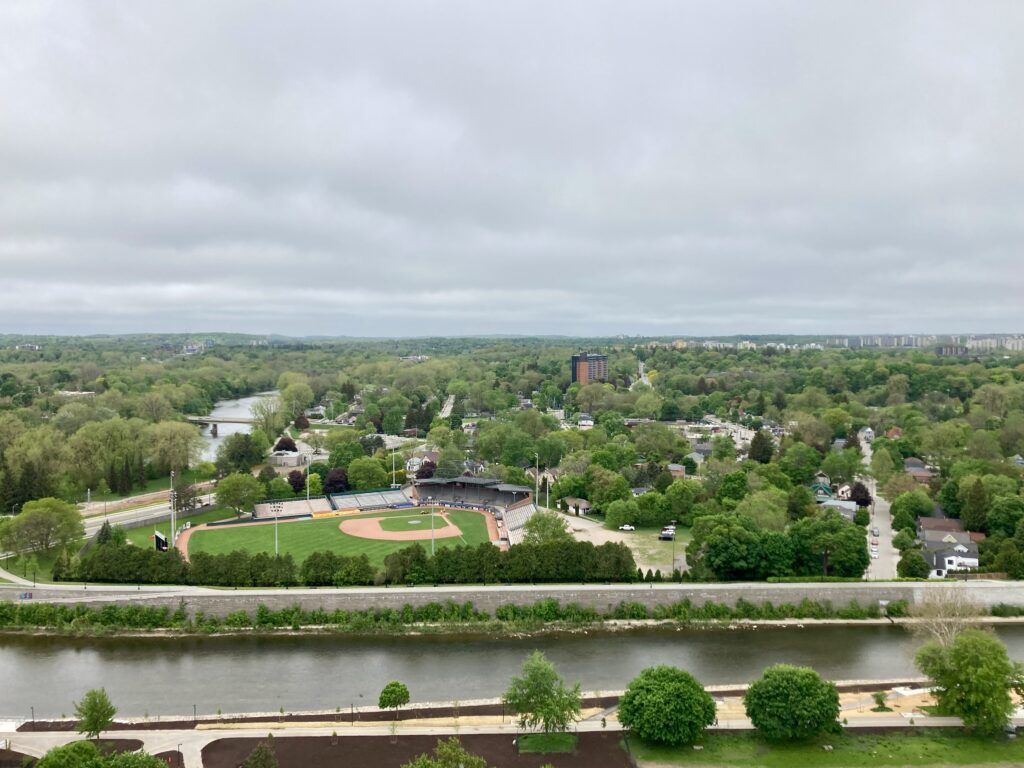
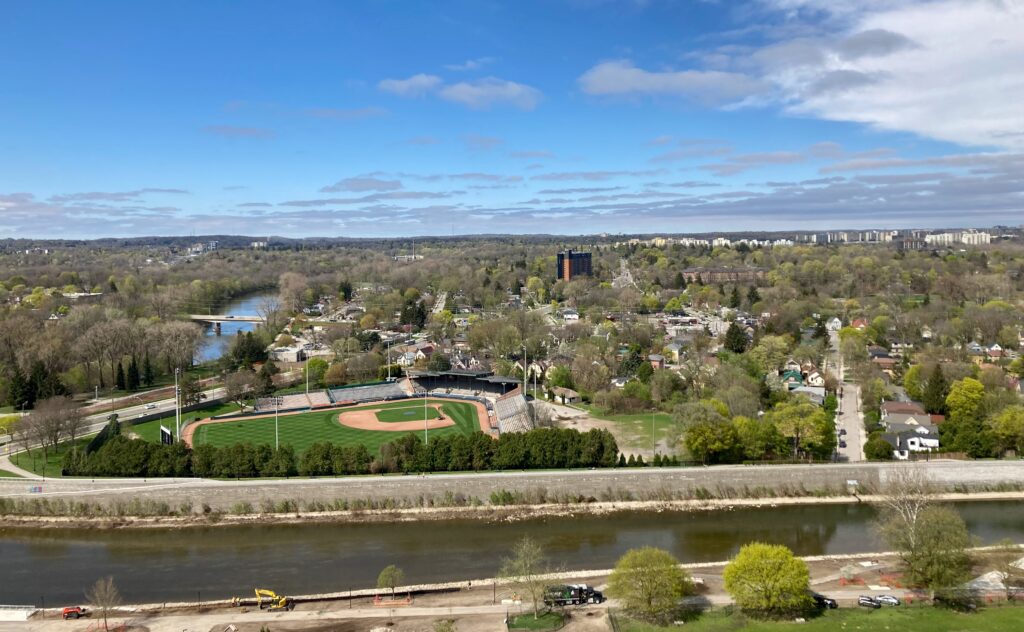
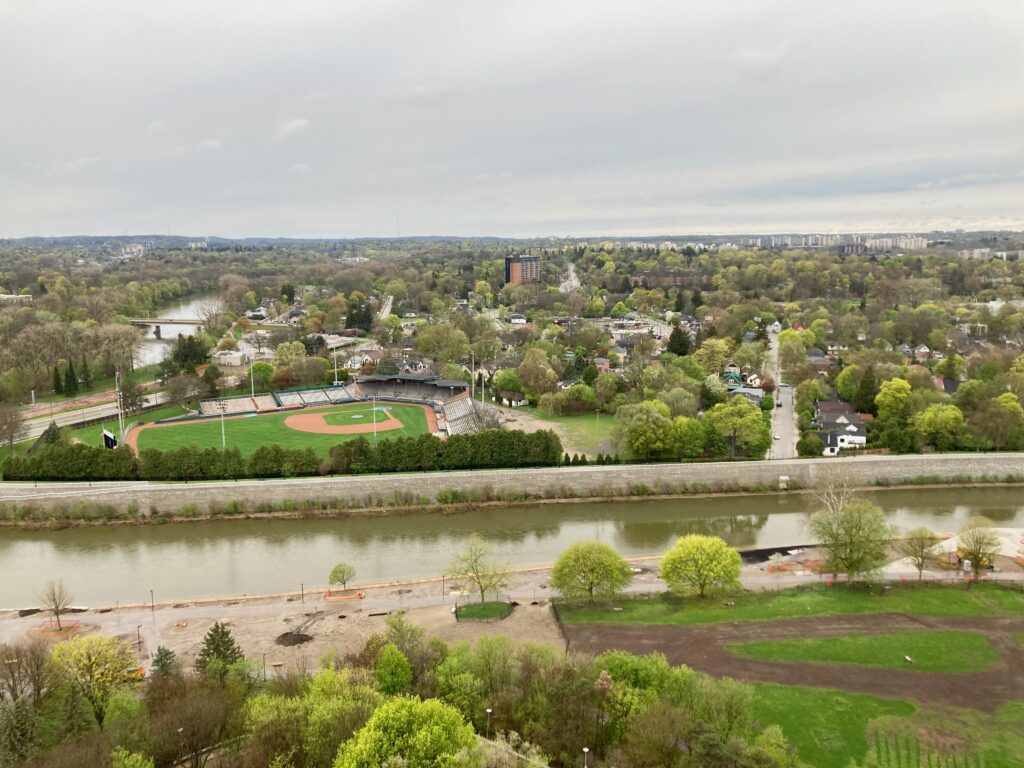
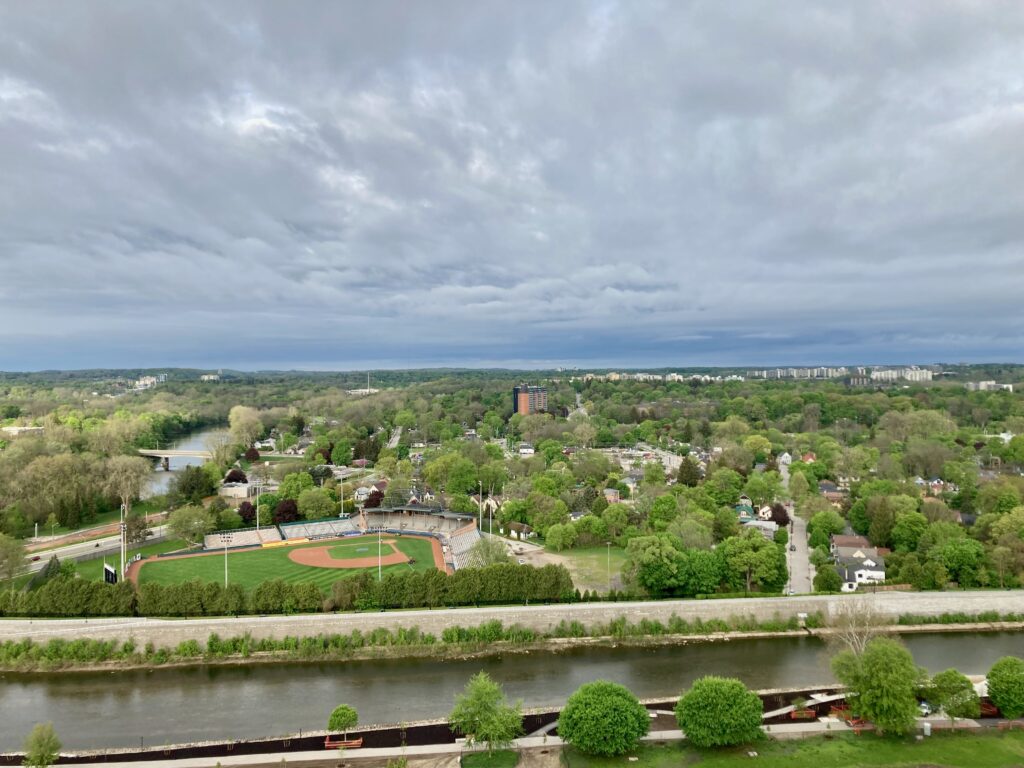
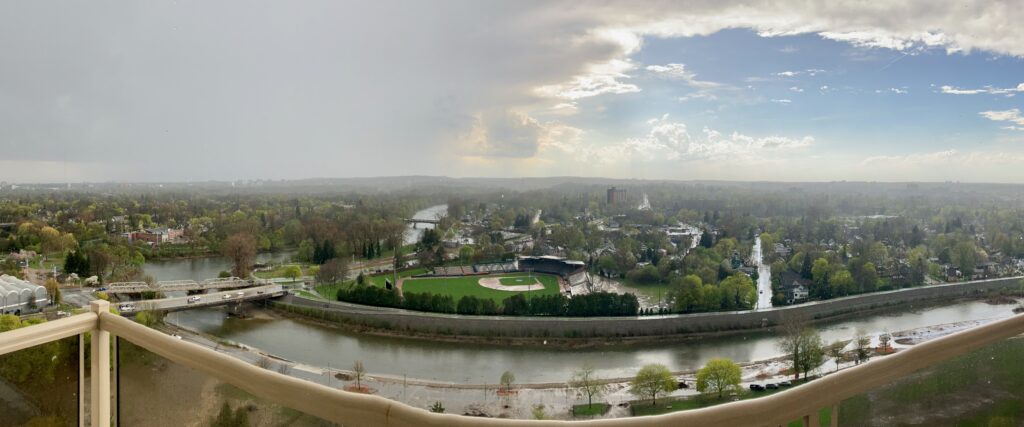
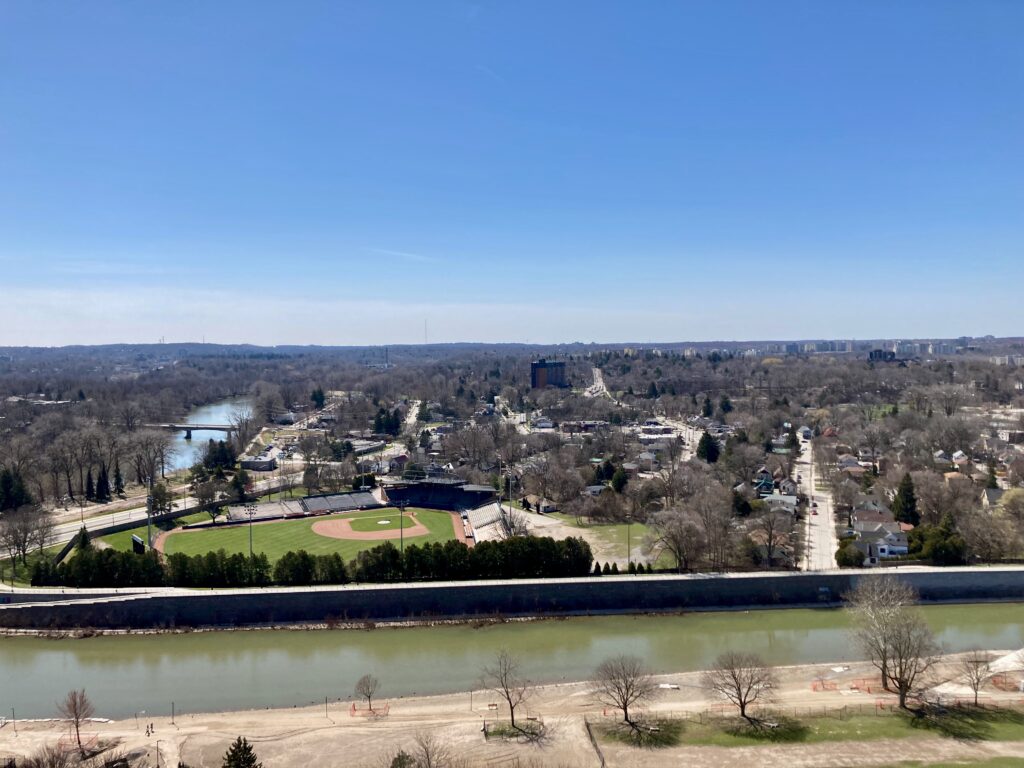
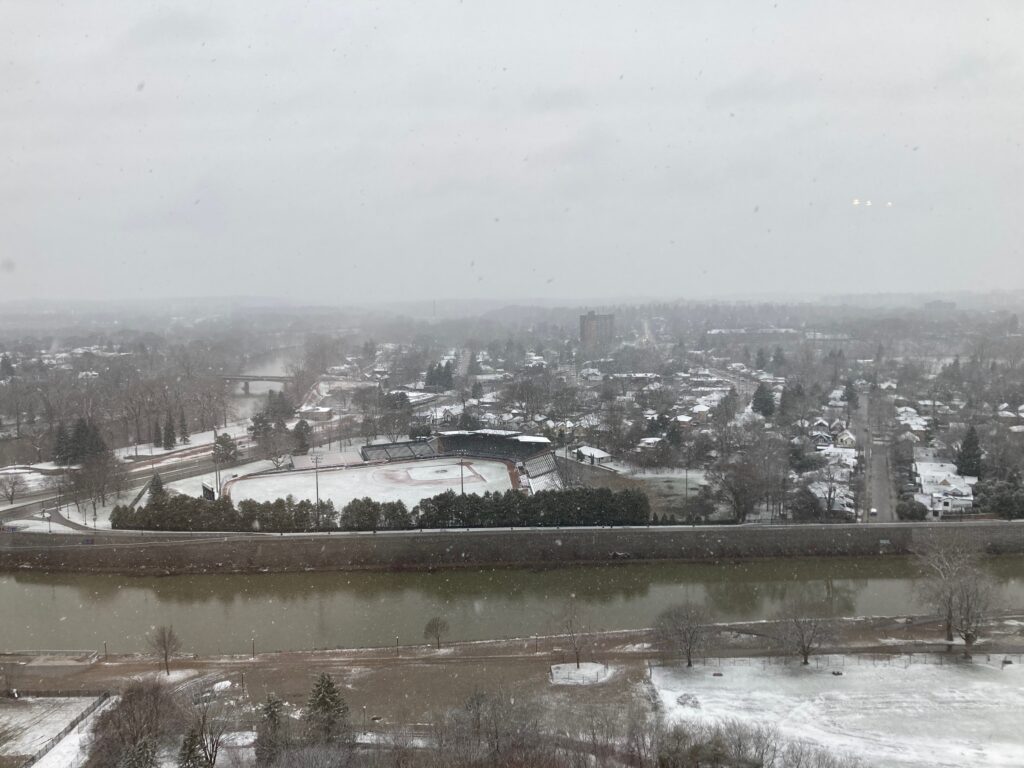
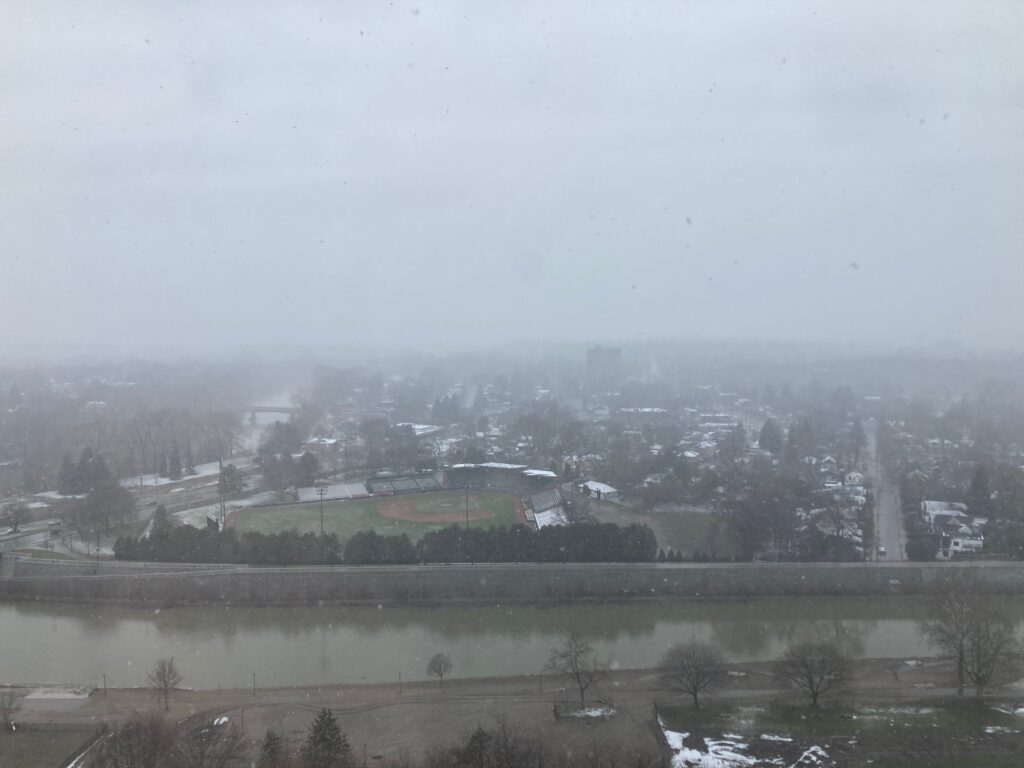
    Our weather continues to be erratic. Sunday, April 13 was sunny and warm with Centigrade temperatures in the mid to high teens. Tuesday, the temperature dropped to 2C but is predicted to be 22C on Friday before it falls to more normal temperatures in the teens after that. At least the sun was shining on Thursday. Friday and Saturday were warm, but overcast and rainy. The grass at the stadium is green. The trees are stillmbare with few signs of buds.

    April 17, 2025

    The Coves – April 13

    According to the Upper Thames River Conservation Authority, “The Coves Environmentally Significant Area (ESA) is centred on a former oxbow of the Thames River. An oxbow is a U-shaped body of water that forms when a river’s meander is cut off, creating an isolated pond or marsh. This former meander is now three separate ponds, as parts of the old channel have filled with sediment. The ESA also contains marshes, ravines, woodlands, and meadows.”

    We first walked along the main pond where there were a few Canada Geese, Mallards and a lone Pied-billed Grebe. Turtles basked on logs on the far side of the pond. It was hard to identify these, but they were likely Red-eared Sliders, released pets that have become invasive. There was pond scum – floating masses of algae – on the pond that indicates degraded water quality that needs to be addressed.

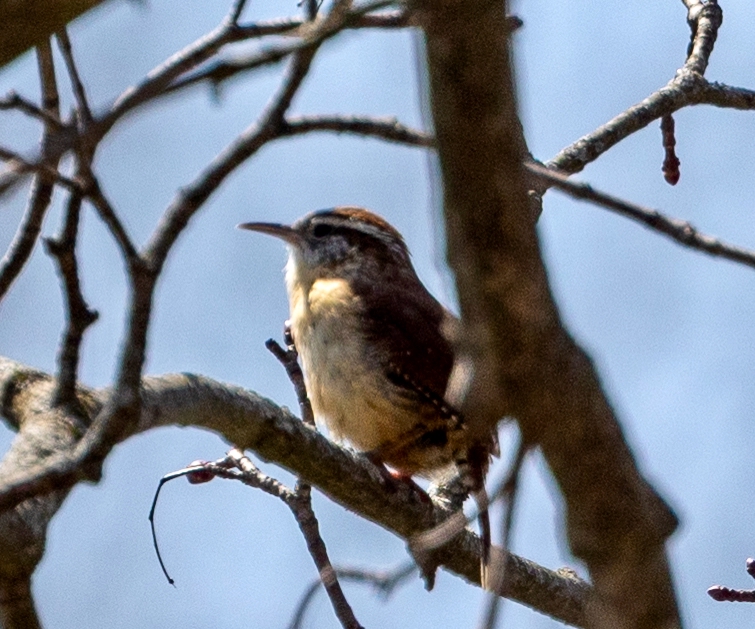
    The birds were singing, but stayed mostly out of sight or high up in the trees. We identified 17 species, including this Carolina Wren.

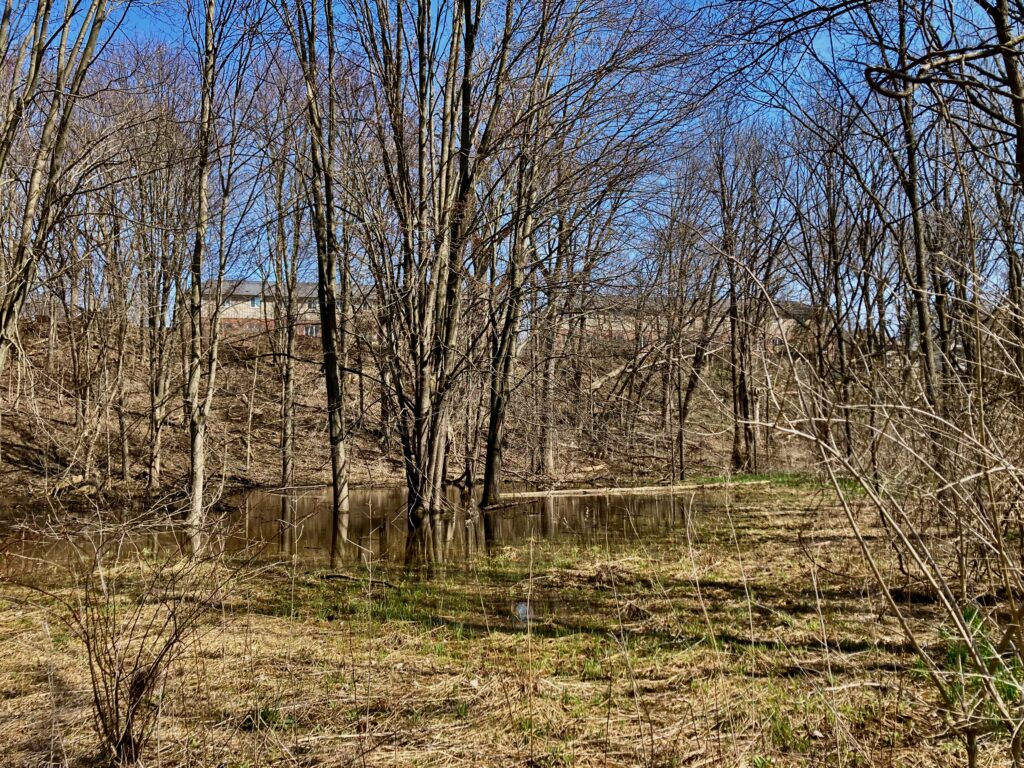
    We walked a trail through a wooded area that was still flooded. In this pond, a few Mallards were foraging watched over by a Canada Goose perched on a stump.

    A pair of Wood Ducks cruised along in another flooded area. What a wonderful sight!

    There were patches of flowers in bloom, all introduced species that have naturalized in the ESA: Scilla, Sweet Violets (purple and white) and Bird-in-a-Bush.

    We came across Cellophane Bees again and caught them on some of the blossoms.

    Alumni Stadium

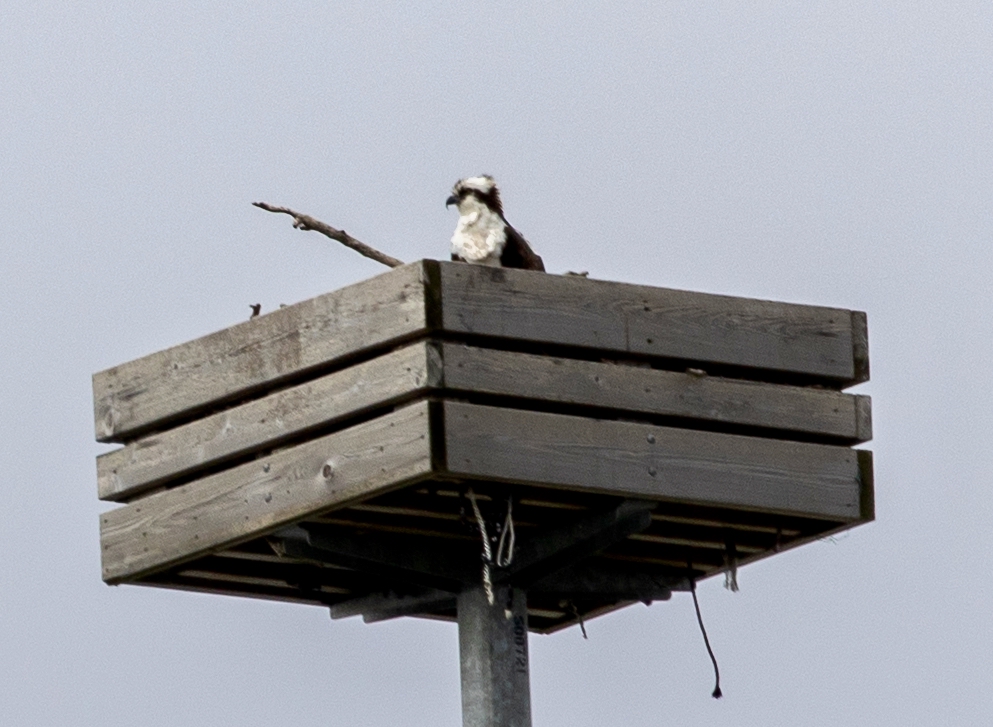
    Here are a few photos that were missed in last week’s post. In addition to the plump American Robin and handsome Mallard drake, is a photo of the Osprey on the nest box at the stadium awaiting its mate.

    Osprey News

    “Our” Ospreys continue to puzzle us and defy expectations. Usually, the male of a pair arrives at the nest site prior to the female. Our female has arrived before her current partner both years they have been together. This year, she arrived on March 27th and he followed on March 30th. Although some Osprey websites indicate that a three-week period of courtship follows the reunion of the pair, we have witnessed few of the courtship behaviours described. These include the pair spending time on the nest together, the male bringing food to the female and performing aerial displays before mating. Our pair did spent time on the nest together, initially far apart and then more closely for a few days around April 3rd and 4th. After that, we most often saw the female standing on the nest and the male perched on the low platform. We did not see any deliveries of fish to the female, but our observation time has been limited by the weather conditions. Most often, we saw one of the pair feeding on the low platform, sometimes with the second standing nearby. In one photo, it appears to be the female consuming the fish while the male stands by.

    Recently, from about April 13th, we have seen the female sitting low in the nest through all kinds of weather. This indicates to us that she is likely sitting on an egg. We clearly have missed any mating that took place! Some accounts indicate that eggs are laid one to three days after copulation. The female lays between one and four eggs one to three days apart. The eggs hatch in the order they were laid after an incubation period of 34 to 40 days. While the female is usually the one to incubate the eggs, we recently witnessed the male sitting low in the nest when the female returned. He then lifted off, only to circle back and land on the female’s back. This is the first time we’ve seen copulation (captured in the video below) this year.
    Now that the weather has allowed us to leave the balcony door open and video life on the nest more frequently, we have witnessed the female another unexpected role for the female. While she was on the nest, an intruder flew low over the nest. The female rose up to fend off the intruder. Shortly afterward, the male arrived on the nest and both male and female mantled their wings to protect the nest as the intruder returned. It was then the female that took flight to chase the intruder away. See the action in the second part of this video.

    Two screen shots from the video (45 seconds from the start) show are from the first approach of the unwelcome visitor. The female was alone on the nest and lifted up to repel the intruder (above her) before it could land. Most of the second attack action is off-screen and I have no good clips. That time, the male was covering their eggs while she left the nest and started flying at the intruder.

    Again on Saturday, the female sent up an alarm call from the nest when another Osprey approached. The male was perched on the low platform and mantled his wings over the platform. As the intruder swooped low over the platform, the male rose up to repel it. The male then flew to the nest and mantled while the female took flight and chased the intruder until it flew a good distance beyond the stadium and the river. This female is a force to be reckoned with!

    Flower Farm News

    Saturday was the first day of the outdoor market at Covent Garden Market in downtown London. The Wandering Bee was there with tulips to brighten the day. The flower season has begun!

    1964

    This was the name of one of the many Beatles tribute bands. It was the year The Beatles came to America, appeared on The Ed Sullivan Show, and released A Hard Day’s Night. But there were other musicians that year. Here is my playlist.

  • Ross Park & More  –    April 6 to 11, 2025

    Ross Park & More – April 6 to 11, 2025

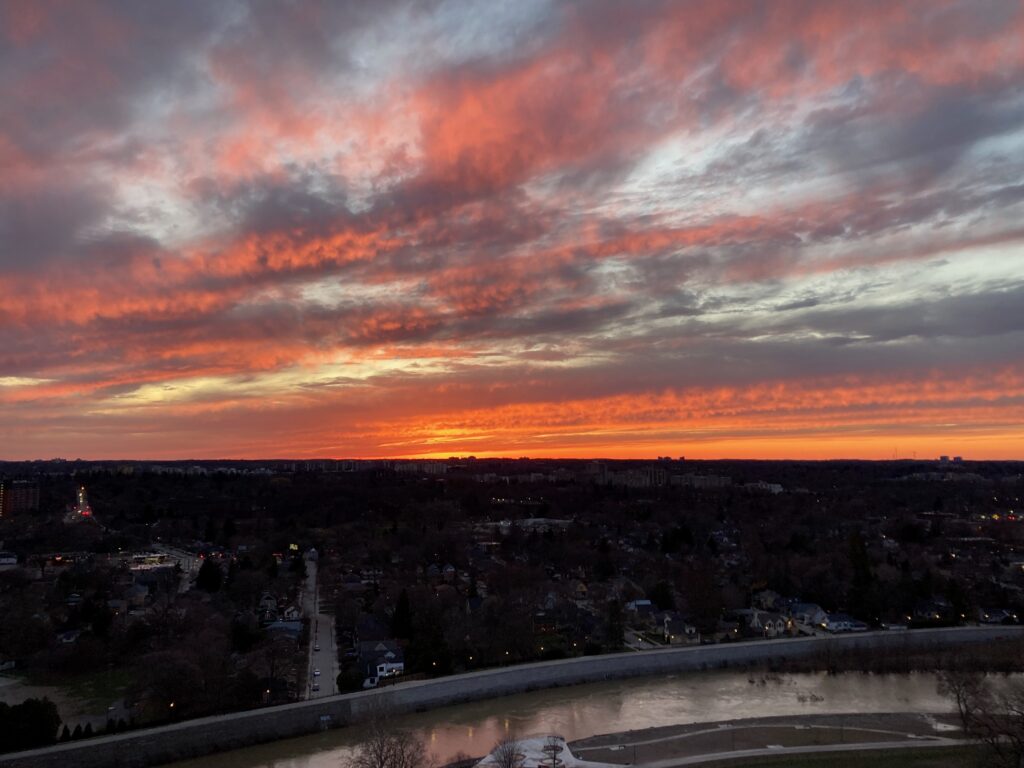
    April’s weather continues to be erratic. A sunny day on Sunday followed last week’s heavy rain and flooding. Despite the “red sun at night” on Sunday, the gathering clouds brought snow on Monday that stayed on the ground through Tuesday’s cold temperatures. From an overnight low of -10C on Tuesday night, the temperature is expected to rise to 14C by Saturday…In the meantime, we woke to snow on the ground on Thursday. Snow continued throughout much of the day before turning into a mix of rain and wet snow.

    Snow on Monday, April 7 and Tuesday April 8, 2025

    Ross Park

    Our Sunday walk was in Ross Park, a small pocket park near the Western University campus that now has a pedestrian bridge across the Thames. A cycling and pedestrian path along the river leads to the North London Athletic Fields on the far side of the river.

    There are several Northern Red and White Oak trees in the park, including a gnarly old oak near the parking lot. Acorns and oak leaves littered the ground below the trees.

    We noticed several bees hovering just above the warm soil and sometimes landing briefly. iNaturalist identified these as a kind of Cellophane Bee. According to Wikipedia, these are solitary ground-nesting bees that build cells in underground nests that are lined with a cellophane-like plastic secretion.

    Most trees were bare and only a few plants were in bloom or showing signs of life. Some violets, Scilla, Lesser Celandine, Wild Garlic and Bull Thistle are introduced species that have naturalized in our parks. Lesser Celandine and Wild Garlic are considered invasive because of their spreading habits.

    As we walked, the air was filled with birdsong. We identified 13 species of birds. A large flock of American Robins foraged on the ground. A few birds called from perches.

    Brown-headed Cowbirds and a cardinal also foraged on the ground.

    Song Sparrows were in full voice.

    Red-winged Blackbirds trilled from the river’s edge.

    A Bald Eagle soared overhead and another kind of bird.

    Western University Alumni Stadium Trail

    We took a short walk along the trail by the Alumni Stadium where we were happy to see an Osprey perched on the nest box high above the stadium lights. It looks like Ospreys will nest there again this year.

    There were signs of emergent life in the mostly dormant landscape.

    Osprey News

    We are somewhat puzzled by our Ospreys’ seeming lack of courtship or mating behaviour. Perhaps we’ve missed it. The male has been successful in catching fish despite the opaque muddy water in the Thames. He consumes it on the low platform. We haven’t noticed that he takes what remains of the fish to the female on the nest. More often, we have seen her on the low platform with him, presumably waiting for her turn with the fish.

    Although they had been spending more time side by side on the nest, more recently we usually see the female alone on the nest. When he is present, the male usually perches on the low platform, even when he has no fish. We have wondered whether this is a repeat of last year’s standoff over where to establish the nest. Time will tell.

    Perhaps the cold and windy weather has dampened the Osprey pair’s spirits. It has certainly made it difficult for us to set up video surveillance to follow their interactions more closely.

    During times of high wind and snow, the female Osprey has spent time off the nest, but always returns. Here she is after the snow on Thursday, weathering the rain that is falling.

    Two More Years of Rocking Songs: 1962 and 1963

    What do you think happens in 1964? There are softer songs I like from before 1964 to review.

    Playlist for 1962

    Playlist of 1963